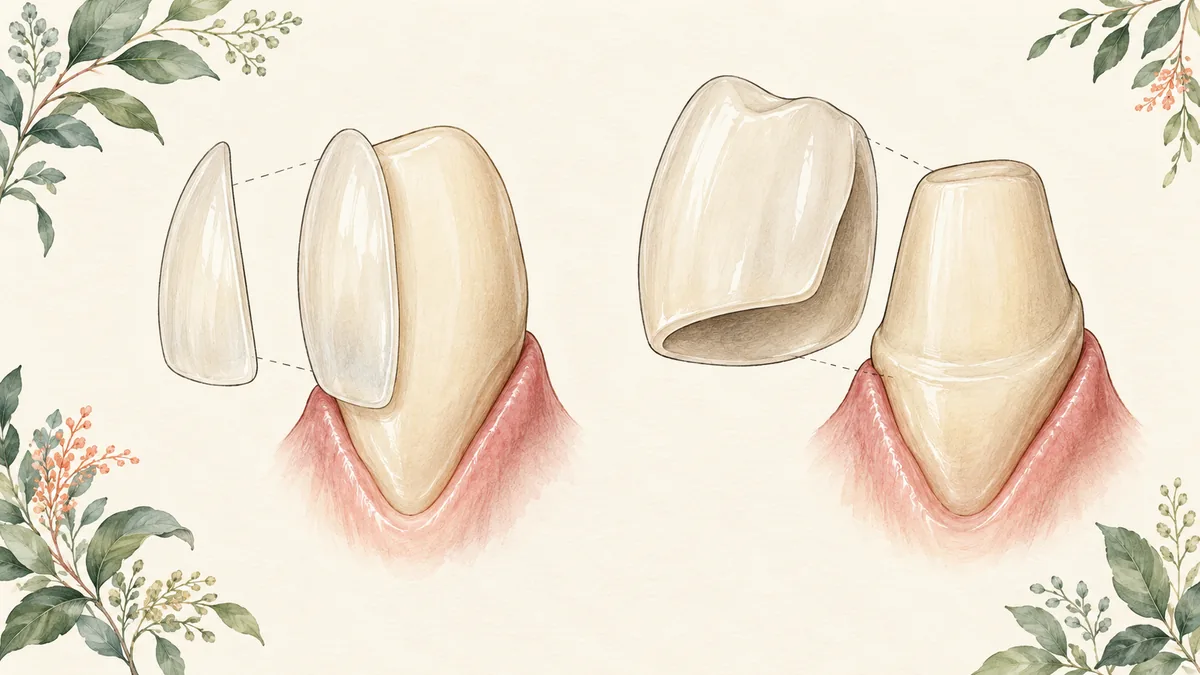
The label covers both, so what matters is the treatment planned for each tooth, because the two remove very different amounts of tooth.
This page explains the difference, shows how to read a quote, and points to the pages on risk. It is part of the full guide to what “Turkey teeth” means.
What is a veneer?
A veneer is a thin shell, usually of porcelain or tooth-coloured resin, bonded to the front of a tooth to change its colour, shape or apparent length. Patient information from Leeds Teaching Hospitals says veneers usually involve removal of some tooth structure, but not as much as for a crown.3
For a veneer, says the NHS, the front of the tooth is drilled away a little, but not all veneers need this.2
A systematic review and meta-analysis of 13 studies of ceramic veneers found cumulative survival of 89% at a median of nine years, with fracture or chipping the most frequent complication.4 These are pooled studies, not figures for Turkey.
The NHS describes veneers as generally only available privately unless you can show a clinical need.2 Our guide to dental veneers covers them in full.
What is a crown?
A crown fits over the whole visible part of a tooth. The Leeds leaflet describes it as fitting over a tooth that has been re-shaped by the dentist,3 and the NHS says the old tooth needs to be shaped for the crown to be fixed on to.2
The Leeds leaflet gives a tooth weakened by a large filling or decay, tooth wear, or a root filling as reasons for a crown.3 The NHS adds that crowns can also be fitted just to make a tooth look better.2 That last case deserves a closer look, because it can mean shaping a sound tooth.
What “Turkey teeth” crowns are made of
The Leeds leaflet names porcelain fused to metal, metal alloy and all-ceramic crowns.3 Names on a quote may include zirconia and lithium disilicate, often sold as “E-max”, which are both ceramics.
A systematic review of 67 studies of single crowns found five-year survival of about 91% to 97% for most materials.5 In the same review, zirconia sat at the low end at about 91–92%, older feldspathic or silica-based ceramic crowns did worse, and zirconia was more prone to chipping or coming loose.5 Those are pooled estimates, not figures for Turkey; how long they last weighs them up. A quote should name the material (zirconia and e.max compared).
How much tooth is removed in each?
The most-cited measurements come from a laboratory study that used resin model teeth, not patients. Veneer and resin-bonded bridge-retainer preparations on front teeth removed roughly 3% to 30% of the crown by weight, depending on the design, while full-crown preparations removed roughly 63% to 72%, as reported in the Journal of Prosthetic Dentistry study.1
Tooth structure
How much of a front tooth is prepared?
Veneer preparation

Mainly the front surface; the extent varies with the design.
Full crown preparation

The visible tooth is reduced all the way round.
The study covered front teeth only, so treat the figures as an order of magnitude. Full-crown preparations removed roughly 2.4 to 4.3 times as much tooth as the veneer preparations, according to the authors’ results.1
| Feature | Veneer | Crown |
|---|---|---|
| What it covers | The visible front of the tooth | The whole visible tooth |
| Tooth removed, lab model of front teeth | About 3% to 30% by weight (veneer and bridge-retainer designs) | About 63% to 72% by weight |
| NHS description | Front drilled away a little; not all designs need this | Old tooth shaped to carry the crown |
| Reversible | No — tooth preparation is permanent | No — tooth preparation is permanent |
Why do clinics sometimes call crowns “veneers”?
We found no research that counts how often a quote uses “veneer” for what is clinically a crown, so we cannot say how common it is, and we assume no bad intent. There are reasons the words blur: everyday speech uses “veneers” for almost any cosmetic cover, and veneers themselves are not one design.
- Everyday language. In ordinary speech, “veneers” has come to mean almost any cosmetic cover on a tooth.
- Veneers are not one design. In the laboratory study above, veneer and resin-bonded retainer preparations together ranged from about 3% to 30% of the tooth removed.1
A veneer covers the front of a tooth. A crown surrounds the whole visible tooth. If a quote describes complete or full coverage, it is describing a crown, whatever else it is called.
How can you tell what you were quoted?
Read the quote tooth by tooth. A clear written plan states, for every tooth, whether it is a crown or a veneer, the material and laboratory, what will be removed, the number of visits and the guarantee terms, and whether X-rays or scans were taken first. Ask the question that each phrase below prompts.
- “Veneer”, “laminate” or “facial shell”: is any enamel removed, how much, and does the shell wrap over the biting edge?
- “Crown”, “full-coverage” or “complete”: does this particular tooth need a crown, and why not a veneer or bonding?
- “Minimal-prep” or “no-prep”: what exactly is taken from each tooth? These phrases describe an intention, not a measurement.
- A material name only: is this a crown or a veneer, and which laboratory makes it?
If you have already had treatment and are unsure what you received, ask the clinic for your records and X-rays and take them to your own dentist. Our guide to crowns vs veneers helps you read an offer, and our page on before-and-after photos explains why a photograph alone cannot tell you which one a person has.
Why does this change the risk picture?
A review of tooth repair and regeneration research states that damaged enamel cannot be biologically regenerated.6 The extra tooth a crown takes is gone, and any later replacement is made on what remains. That is why a crown is the bigger commitment, and on a sound tooth it deserves a harder look and a clear reason.
On a tooth that is already broken or heavily filled, a crown may be well worth making.
Our page on tooth preparation covers what can follow, including the possibility of root canal treatment, and the evidence on how often. See also when it goes wrong.
Frequently asked questions
-
Are Turkey teeth veneers or crowns?
The phrase is used for both, so it cannot answer the question. A veneer covers the front of a tooth and a crown covers the whole visible tooth, and they remove very different amounts of tooth. Only the written plan for each tooth tells you which you are being offered. See our guide to crowns vs veneers.
-
What is the difference between a crown and a veneer?
A veneer is a thin shell fixed to the front of a tooth, while a crown surrounds the whole visible tooth. In one laboratory study of front teeth, veneer and resin-bonded bridge-retainer preparations removed roughly 3% to 30% of the crown by weight, against roughly 63% to 72% for full crowns. Our tooth preparation page explains the consequences.
-
What are Turkey teeth made of?
It depends on the plan. Hospital patient information names porcelain fused to metal, metal alloy and all-ceramic crowns, and research compares glass-ceramic, zirconia and others. We found no verified source on which materials are most used in Turkey, so ask the quote to name the material and laboratory. Our guide to veneers describes the shells.
-
Do all veneers involve drilling the tooth?
No. The NHS says the front of the tooth is drilled away a little for a veneer, but not all veneers need this. Whether a thinner design suits you depends on your teeth, and a dentist has to examine them. Ask what will be removed from each tooth, and read our tooth preparation page first.
-
How can I tell whether I have had crowns or veneers?
Check the written plan or invoice for words such as crown, full-coverage or complete coverage, which describe crowns, and for veneer, laminate or facial shell. If the paperwork is unclear, ask the clinic for your records and X-rays and show them to your own dentist. Our Turkey teeth guide explains why it matters.
-
Is a crown always worse than a veneer?
No. A crown removes more tooth, but it can be the right treatment for a tooth that is broken, heavily filled, worn or root-treated. The concern is a crown on a sound tooth for appearance alone, where a less invasive option might do. Ask why this treatment suits this tooth, and see crowns vs veneers.