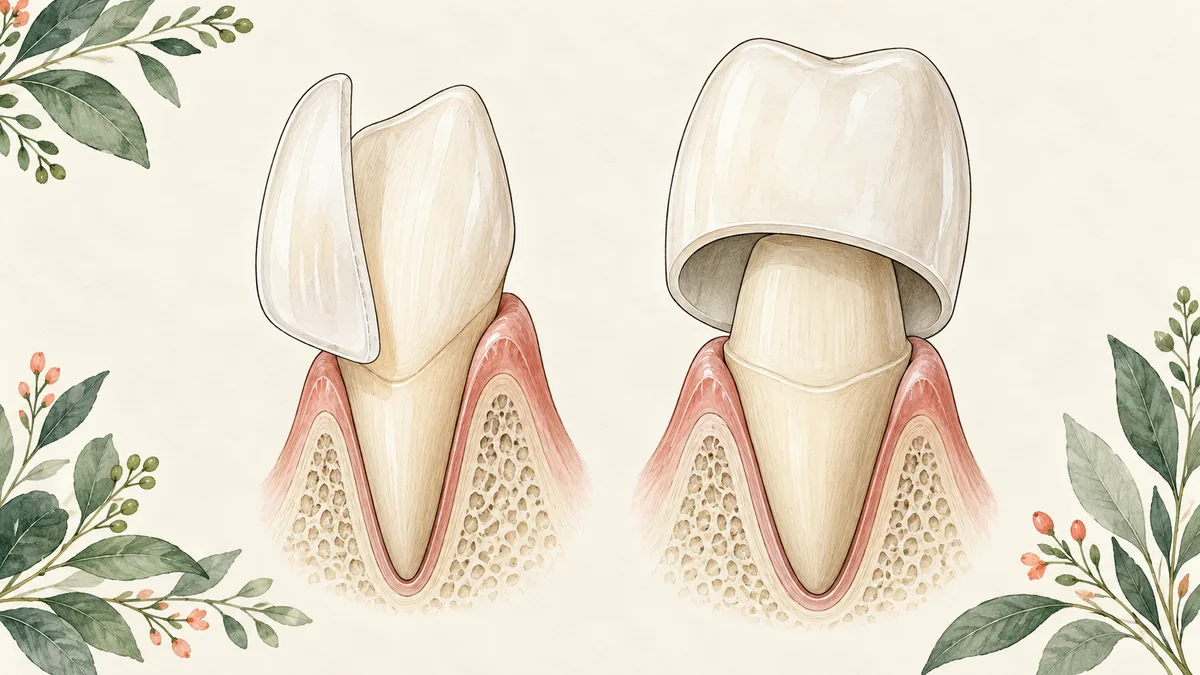
If you have been quoted for treatment, read this page before you compare prices. A crown and a veneer both change how a tooth looks, but they are very different operations on the tooth underneath, and the words are often used as if they were interchangeable.
We set the two side by side, say when a crown is the right treatment and when it is more than the tooth needs, and show how to read a quote, while our guide to cosmetic treatments covers the other options. For the vocabulary of “Turkey teeth” marketing, see what they actually are, and for the bigger picture, our Turkey teeth guide.
Crowns vs veneers: how do they compare side by side?
A veneer covers the front of a tooth, while a full crown surrounds all of it, and both preparations are permanent. The figures come from different kinds of research, so read the notes beneath it.
| Feature | Veneer | Full crown |
|---|---|---|
| Coverage | Front surface, sometimes the biting edge | All the way round the visible tooth |
| Tooth removed, lab model of front teeth1 | About 3% to 30% by weight (veneer and bridge-retainer designs) | About 63% to 72% by weight |
| Reversible | No — tooth preparation is permanent | No — tooth preparation is permanent |
| Usual reason | Sound teeth where the aim is cosmetic: colour, shape, small gaps | Teeth that are broken, heavily filled, root-filled or badly worn |
| Survival in pooled3 studies4 | 89% at a median of 9 years (ceramic) | About 91% to 97% at 5 years for most materials |
| Commonest problems | Fracture or chipping, then debonding3 | Zirconia crowns: more veneering-ceramic fracture and loss of retention than metal-ceramic4 |
| Nerve death after preparation, pooled analysis6 | About 5% of teeth after indirect restorations, mainly crowns and bridges; low certainty | |
A veneer covers the front of a tooth. A crown surrounds the whole visible tooth. If a quote describes complete or full coverage, it is describing a crown, whatever else it is called.
The tooth-removal figures come from resin model teeth in a laboratory, not from patients. The veneer survival figure is for ceramic laminate veneers, whereas the crown figure is for single crowns. And we found no trial comparing the two for the same cosmetic aim, so no table can tell you which will last longer in your mouth.
When is a crown genuinely the right choice?
Sometimes the crown is the correct treatment. An NHS hospital leaflet lists a tooth weakened by a large filling or decay, tooth wear and a root-filled tooth as reasons to fit one.2 In those cases the choice is between a damaged tooth and a protected one, and a veneer would not protect it.
Our page on dental crowns covers those cases in more detail. The leaflet also notes that a crown may be unsuitable for people who clench or grind, for young patients and where hygiene is poor.
Crowns also have a track record. A systematic review of 67 studies put five-year survival of single crowns at about 95% for metal-ceramic and about 91–92% for zirconia, with zirconia crowns showing more veneering-ceramic fracture and loss of retention than metal-ceramic.4
When is a crown over-treatment?
The picture changes when the tooth is sound and the reason is appearance. A full crown on a healthy tooth takes, in laboratory models,1 roughly 2.4 to 4.3 times what a veneer does, and what is taken cannot be put back. Our page on tooth preparation explains more.
There are also biological costs. In a meta-analysis of 37 studies, the nerve died in about 5% of teeth after indirect restorations, which in the studies reviewed were mainly crowns and bridges, and periapical disease developed in about 3.6%.6 The certainty was low, and it cannot tell you the figure for a crown or a veneer alone. Risk rose with existing decay or restorations (in one study), front teeth and temporaries left in place for over two weeks. A veneer-only analysis found nerve problems in about 2% of ceramic veneers.3
Replacement matters too. NHS claims data for 47,474 crowns measured time to any further treatment of the tooth, and found 68% of metal crowns and 48% of all-porcelain crowns still untouched at ten years.5 Those crowns were placed from 1990 to 2002 with older ceramics, so they are not a modern failure rate.
The question is whether the tooth needs the crown or the crown is simply what is on offer. Where the tooth is sound, bonding instead of crowns looks at the additive alternative.
What does preparation look like for each?
Seen from the biting edge, a veneer preparation takes a layer from the front only, while a crown preparation takes a layer all the way round, leaving a smaller, tapered core. A failed crown leaves little tooth for the next one. With a veneer more of the tooth stays, but the front surface is still gone.
Viewed from the biting edge
Front surface versus all round
Veneer: front only

Removed tissue on the lip-facing surface.
Crown: all the way round

Removed tissue around the tooth.
How do you read your quote?
A quote that says only “20 veneers” or “smile makeover” does not tell you what will be done to each tooth. Look for the design, the number of teeth, the material, the preparation and the records, and ask if they are missing.
- The design, tooth by tooth. If the quote gives a total, ask for the breakdown.
- The number of teeth. “Units” can mean crowns, veneers or the teeth of a bridge, which are not the same thing.
- The material, separately from the design. E-max (lithium disilicate) and zirconia are materials, and either can be used to make a crown or a veneer. Naming one tells you nothing about how much tooth is removed.
- A package name is not a design. Terms such as “Hollywood smile” describe a goal, so ask what will be placed on which tooth. Our page on smile makeovers and the Hollywood smile explains what sits behind the terms.
- The preparation. Ask how much of each tooth will be removed and whether a less invasive option was considered.
- The records. Ask whether X-rays are taken before the plan is made and whether the plan is written down.
Which less invasive options should you consider first?
A sensible order runs from the least invasive to the most: bonding, then veneers, then crowns. The NHS hospital leaflet notes that teeth can sometimes be rebuilt with a white filling that sticks to enamel, and that the best option is often the one that keeps as much natural tooth as possible.2
Our guide to composite bonding covers the additive route, which removes little or no tooth but has trade-offs of its own, and our veneers guide covers the middle step. Neither suits every mouth, and a dentist who has examined you has to decide.
Frequently asked questions
-
Is a crown better than a veneer?
Neither is better overall. A crown protects a tooth that is broken, heavily filled, root-filled or badly worn, while a veneer suits a sound front tooth for a cosmetic aim. A crown takes roughly 2.4 to 4.3 times more tooth in laboratory models, so on a healthy tooth it deserves a harder look. See our page on tooth preparation.
-
Are Turkey teeth crowns or veneers?
“Turkey teeth” is a popular label, not a clinical term, and quotes use the word veneer loosely. What matters is what each individual tooth will receive, so ask for a crown or veneer to be named tooth by tooth. Our guide to what Turkey teeth actually are explains the wording in more detail.
-
Which lasts longer, crowns or veneers?
We found no trial that compared them for the same cosmetic aim, so nobody can give you a fair answer. An NHS hospital leaflet says either should normally last around 8 to 10 years if properly cared for. Studies of each show good survival, but they measure different teeth. See our veneers guide for the veneer evidence.
-
Can I have veneers instead of crowns?
Sometimes, but it depends on the tooth. A tooth that is broken, heavily filled or root-filled may need a crown for protection, whereas a sound tooth might be treated with a veneer or with bonding. Only a dentist who has examined you and seen X-rays can say which. Read about composite bonding first, as it takes the least tooth.
-
Can a crown be reversed later?
A crown can be removed, but the tooth cannot be returned to how it was. The enamel and dentine taken away are gone, and the tooth underneath is prepared again when a crown is replaced. That is why the decision deserves time. Our guide to tooth preparation explains what is lost and what can follow.