Implants are the treatment most often presented as quick, and the one where speed matters least. Searching for dental implants in Turkey usually means comparing schedules as well as prices, so this page starts with what an implant is, because the timetable follows from the biology.
We do not rank clinics, and we describe nothing here as typical of Turkey, because we found no verified outcome data for implants placed there. Full-arch treatment such as All-on-4 has its own page, and our guide to cosmetic treatments sets implants beside the other options.
How does a dental implant work?
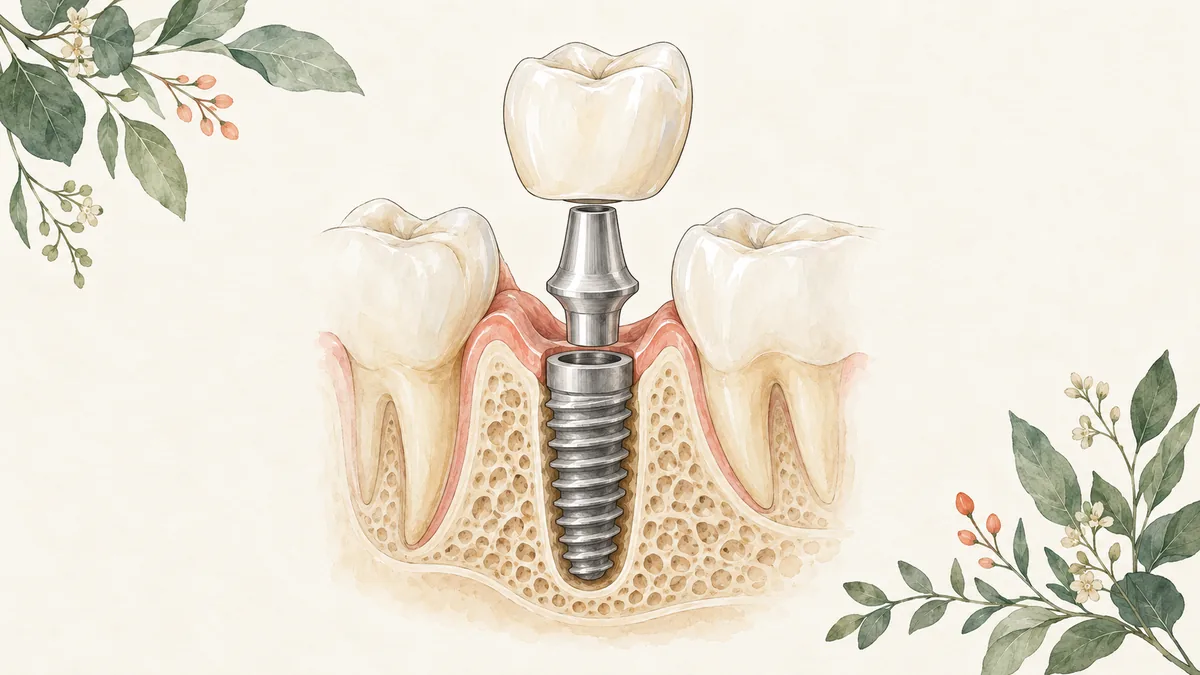
The NHS guidance on dental treatments describes an implant as a titanium screw placed into the jaw bone to support a crown, bridge or denture.1 That means one implant can carry a single crown, several can carry a bridge, and a small number can hold a denture in place. In practice every implant has three parts.
- The fixture is the post that is placed in the bone and takes the place of the root.
- The abutment is the connector that rises through the gum and holds the visible tooth.
- The restoration is the crown, bridge or denture that you see and chew with.
One NHS trust leaflet describes the stages as assessment, an optional bone graft, placing the implant, and fitting the restoration.3 The same leaflet notes that parts can loosen or wear out over time. Each stage is a separate decision, so each should appear in your written plan, with the person responsible for it named. A plan that jumps from “consultation” to “teeth fitted” has left out the stages where most of the judgement happens.
The timeline problem: why do implants take months, not days?
An implant has to join with the bone around it before it can carry a full chewing load, a process called osseointegration. Dentists then decide when to load it. In a Cochrane review of loading times, conventional practice is to keep implants free of load for three to eight months while this happens.4
A Cambridge hospital leaflet gives three to six months, which can be longer, and says total treatment is usually at least a year;2 a Leeds leaflet gives 2 to 6 months.6
Treatment timeline
Why a dental implant takes several stages
- 01Assessment
The mouth, bone and medical history are checked. A bone graft, if needed, adds time.
- 02Placement surgery
The implant fixture is placed in the jaw bone.
- 03Healing and bone fusion
Leeds gives 2 to 6 months; Cambridge gives usually 3 to 6 months and sometimes longer.
- 04Final restoration
The connector and visible crown, bridge or denture are fitted after the planned healing stage.
An NHS hospital leaflet says the whole course is usually at least a year.
The same Cochrane review looked at placing a tooth earlier. The review included 26 trials with 1,217 people; in the trials comparing immediate with conventional loading, it found no evidence of a difference in first-year implant failure.4 Overall it found no convincing evidence of an important difference between loading times. Two cautions apply: follow-up was only four months to a year, and the search ended in 2012, so it says little about how those implants fared over a decade. Immediate loading also has its own criteria: the review’s authors conclude that a high insertion torque, a measure of how firmly the implant sits in the bone when it is placed, of at least 35 Ncm seems to be one of the prerequisites for successful immediate or early loading.4
What this means for a compressed schedule is not that fast loading is wrong. It means it is a clinical decision, made implant by implant, and it is reasonable to ask for the reason. If a plan finishes in days, ask whether the tooth you leave with is temporary or final, what happens while the bone heals, and who checks that it has healed. We explain the trip-planning side in why implants need longer, and what to consider before flying home after implant surgery in flying after dental surgery.
When is bone grafting or a sinus lift needed?
An implant needs enough healthy bone to hold it. Where bone has been lost, a graft can rebuild it first, and in the upper back jaw a sinus lift makes room above the ridge. The Cambridge hospital leaflet says a bone graft prolongs treatment by at least four months.2
We found no verified figure for how often grafting or a sinus lift is needed, so we give none. The practical point is that needing one lengthens the timetable, so a plan that promises a short stay while also needing a graft needs an explanation.
Who is not a good candidate for implants?
A Leeds patient leaflet lists smoking, poor hygiene, gum disease, jaw radiotherapy, poorly controlled diabetes and some medicines as risks for late failure.6 The Cambridge leaflet adds that smokers fail much more often and are expected to stop at least six months beforehand.2
These are risk factors, not automatic bars. Gum disease and smoking can often be addressed before surgery, and that is the point of an assessment that comes first. A plan that is made without X-rays, a gum check and a medical history cannot take any of this into account.
The practical test is simple. If a clinic has agreed a treatment plan before it has seen your mouth, your medical history or any imaging, it has not assessed you. If you have a condition on the list above, ask how it will be managed before, during and after surgery, and who will manage it once you are back home.
What are the success rates, and what affects them?
Published figures are high, but they measure whether the implant is still in place, not whether the crown on it needed repair. The table gives the main ones, with caveats. None of them is about Turkey, so they describe implants generally.
| Source | Result | Caveat |
|---|---|---|
| Pooled analysis, 18 studies5 | 96.4% at 10 years; 93.2% allowing for people lost to follow-up | Wide prediction intervals (the range a new study might show): 91.5% to 99.4% in one case, 76.6% to 100% in the other |
| Cambridge hospital leaflet2 | 80% to 95% over 15 years with a healthy mouth; 80% to 85% over seven years with gum disease | Patient information, not a study |
| Leeds hospital leaflet6 | About 90% of implants placed 10 years ago still present and working | Patient information, not a study |
The pooled analysis also found age 65 or over was a significant predictor, with a lower 10-year survival of 91.5%.5 Its authors suggested that the risk of implant loss could double in older age groups. We found no verified outcome data for implants placed in Turkey.
“Survival” also has a narrow meaning. It counts an implant as a success if it is still in the mouth, so it does not capture a loose abutment, a chipped crown or inflamed gums. Those are the problems you are more likely to meet, and they are the reason follow-up matters as much as the figures do.
What if an implant fails after you get home?
Late failure is usually gradual: the tissue around the implant becomes inflamed, which is why the Cambridge leaflet stresses regular reviews and careful cleaning.2 That is a long-term job for you and a dentist near you, not for a clinic abroad. Contact your own dentist the same day if an implant feels loose, sore or swollen, or you have a fever or a bad taste.
If you cannot reach one, NHS 111 can advise. Call 999 or go to A&E if it is hard to breathe, speak, swallow or open your mouth, or if there is a lot of swelling in your mouth, face or neck.
Before you travel, ask for a record of the make, size and position of every implant, together with your X-rays. A dentist who did not place an implant cannot easily work on one they know nothing about. Our guide to NHS care and emergencies at home explains who does what, and the page on implant failure covers the signs.
What do dental implants cost?
We do not quote prices here. The NHS says implants are usually only available privately, with limited NHS provision for clinical need, so you will probably be comparing private prices, as the NHS guidance explains.1 Our cost section gives the figures we can verify, with the date each was checked.
The cost section also has separate guides to costs in Turkey and private costs in the UK. When you compare quotes, the stages matter more than the headline: the surgery, any graft, the abutment, the restoration, the check-ups, and what happens if a stage has to be repeated. A quote that lists only “implant” is not comparable with one that lists each.
Frequently asked questions
-
Can dental implants be done in a week?
A tooth can sometimes be fitted on an implant soon after surgery, but that is usually a temporary tooth, and healing into the bone still takes months. A Cochrane review found no convincing evidence of a clinically important difference between loading times, so fast protocols are a clinical decision. Read why implants need longer in our trip planning guide.
-
How long do dental implants last?
In one pooled analysis, 96.4% of implants were still in place at 10 years, falling to 93.2% when people lost to follow-up were allowed for. An NHS hospital leaflet says about 90% placed 10 years ago are still functioning. Crowns and parts can loosen or wear before the implant does. See our guide to implant failure for the warning signs.
-
Who should not have dental implants?
Smoking, gum disease, poor oral hygiene, radiotherapy to the jaws, poorly controlled diabetes and certain medicines all raise the risk of failure, according to an NHS hospital leaflet. They are not automatic bars to treatment, but need dealing with first. An assessment comes before a plan, so check who is doing it and how they are registered.
-
What happens if my implant fails when I am back in the UK?
Contact your own dentist the same day if an implant feels loose, sore or swollen, or you have a fever or a bad taste, and use NHS 111 if you cannot reach one. Call 999 or go to A&E if it is hard to breathe, speak, swallow or open your mouth, or if there is a lot of swelling in your mouth, face or neck. A dentist who did not place the implant may be cautious about taking it on, so keep every record. Our guide to NHS care and emergencies explains who does what.
-
Are dental implants available on the NHS?
Rarely. The NHS says implants are usually only available privately and are expensive, with NHS provision limited to cases such as people who cannot wear dentures after mouth cancer or an accident. For prices we can verify, with the date each was checked, see our cost section before you compare quotes.