Many people who consider treatment abroad say, when asked, that they could not get what they wanted at home. That may be an NHS appointment that never came, or cosmetic work the NHS does not provide. This page sets out, using official sources, how NHS dental care is meant to be reached and what it does and does not cover. It does not argue that the NHS is failing or that it is working; it describes the route so that you can judge it for yourself.
It is one of three pages in this section. The other two look at phasing private treatment and at less invasive options, and the section overview is on the UK alternatives page.
What does the access picture look like?
The NHS’s guidance on how to find an NHS dentist is direct about the main difficulty: you may be asked to join a waiting list, and you may find it difficult to find a local dentist offering NHS appointments. It advises you to contact any NHS dentist directly.1
The page was last reviewed in February 2025 and describes the process in England. If you cannot find a dentist, it points you to your integrated care board, the local NHS body that commissions dental services.
We did not find a reliable national figure, in the sources we have verified, for how many people are waiting or how long they wait, and the position varies from one area to another. We therefore do not quote one. Official statistics exist and change quickly, so check them before relying on any number you see repeated online, including ours.
Access is not the only reason people look elsewhere. Cost, the lack of NHS cover for cosmetic work and the wish for a particular result all play a part, and we have no verified source that separates them or puts a share on each. What we can say is that someone who cannot get an NHS appointment is facing a real problem, and that the sensible response is to plan for it, not to be hurried by it. Treatment abroad is a legitimate choice for some people; our pages on what “Turkey teeth” involves are there to help you make it with the facts in view.
How do you find NHS dental care?
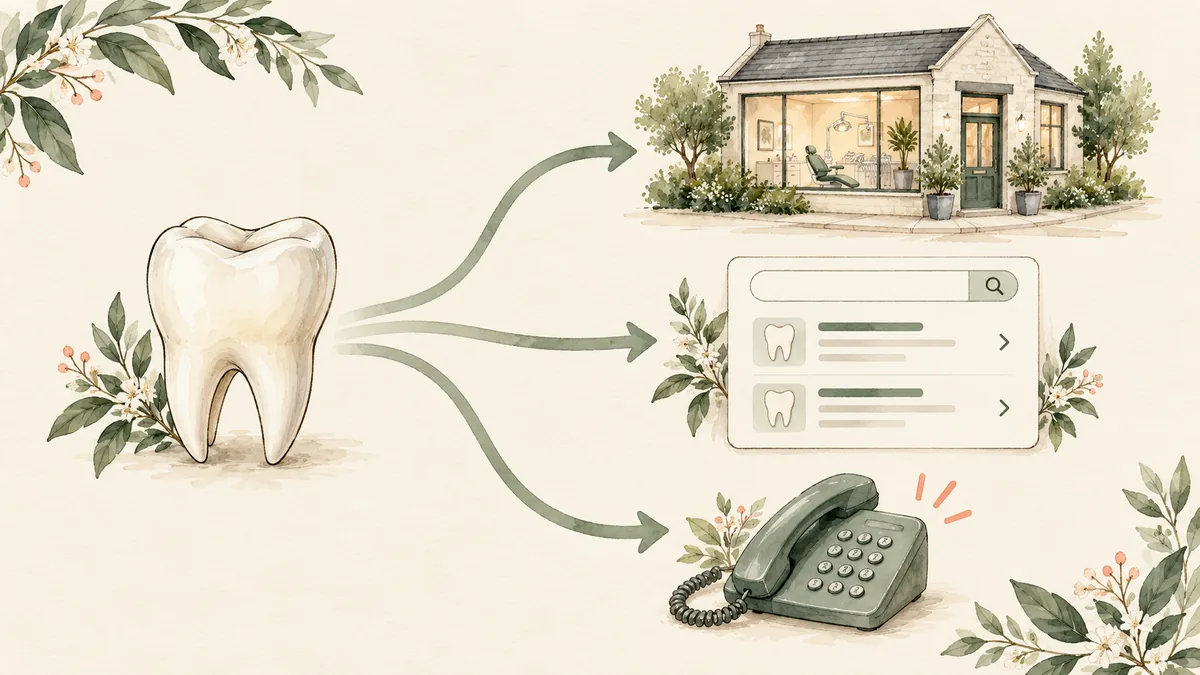
There is no single queue to join. The steps below follow the NHS guidance: search the national Find a dentist service, telephone practices directly, escalate to your integrated care board in England, and use the right source for your nation. None involves a list of named practices, because we do not publish rankings or recommendations.
- Search the national service. The NHS Find a dentist service is designed to show dentists that are accepting new patients or offering urgent care near a postcode.5 It is a starting point, not a promise of an appointment, because availability changes.
- Telephone practices directly. The NHS advises that you can contact any NHS dentist yourself, and ask whether they are taking on NHS patients.1 It is worth asking several, and asking each about its waiting list.
- Escalate in England. If you cannot find a practice, the same NHS page says to contact your integrated care board.1 Write down who you spoke to and when.
- Use the right source for your nation. The page we cite describes England. For Northern Ireland, nidirect’s page on seeing a dentist explains how health service dentistry and its charges work.6 For Wales and Scotland, begin with the national NHS information for your nation.
What does NHS dentistry cover, and what does it cost?
The NHS page on which dental services are available describes NHS dentistry as providing the treatment that is clinically necessary to keep your mouth, teeth and gums healthy, and it states that cosmetic dentistry is usually private.2 In England, what you pay depends on the treatment band, as set out below.
The page also says that a written treatment plan is required for Band 2 and Band 3 treatment, and when NHS and private treatment are mixed, as the same page sets out.2 That plan is worth keeping: it is the record of what was agreed and under which charge.
This matters for anyone whose goal is cosmetic. If the aim is a different shape or colour of healthy teeth, the NHS is unlikely to be the route, however good the access. If a tooth is broken, decayed or painful, it is a different matter: that is treatment the NHS exists to provide.
How the bands work in England
In England the NHS groups treatment into three bands. NHS guidance on dental charges places check-ups, X-rays and scaling, if clinically needed, in Band 1, fillings, root canal treatment and extractions in Band 2, and crowns, dentures and bridges in Band 3.4 The same page adds that further treatment in the same or a lower band within two months is not charged again.4 It also notes that you may be offered a metal-coloured crown on a back tooth, and that crowns may need replacing in future.
| Band | Examples of what it covers |
|---|---|
| Band 1 | Check-up, X-rays, scaling if clinically needed |
| Band 2 | Fillings, root canal treatment, extractions |
| Band 3 | Crowns, dentures, bridges |
| Cosmetic dentistry | Usually private |
The amounts change and differ by nation, so we keep them in one place, our guide to NHS dental charges across the UK. In Northern Ireland, nidirect says a health service dentist works to a set scale of charges, which is published each year.6
What is the urgent care route?
Urgent problems do not follow the waiting-list rules. The NHS page on finding an NHS dentist in an emergency says to call 111 or a dentist for an urgent problem, and that urgent treatment should be available within 24 hours or within seven days, depending on need.3
The same page says an adult tooth that has been knocked out is time-critical and should be seen within one hour.3 A serious injury to the face or jaw, heavy bleeding, or severe swelling of the mouth, lips, throat or neck with difficulty breathing or opening an eye needs 999 or A&E, according to the NHS.3
When to get help
- Your own dentist: toothache, a broken tooth or filling, or a loose crown.
- NHS 111: an urgent dental problem when you have no dentist, or the practice is closed.
- 999 or A&E: difficulty breathing, speaking, swallowing or opening your mouth; a lot of swelling in the mouth, face or neck; a swollen or painful eye or sudden problems with your eyesight; heavy bleeding or a serious injury to the face or jaw.
If your problem follows work done abroad, read NHS care and emergencies at home.
What can you do while you wait?
Waiting is uncomfortable, but it is not the same as doing nothing. These steps keep your options open and your teeth protected: ask to join every waiting list you can, separate what is urgent from what is not, keep a record, consider a staged private plan, and tell any dentist what you are considering.
- Ask to be put on every waiting list you can. Ask each practice how it will contact you and how long you can expect to wait.
- Separate what is urgent from what is not. Pain, swelling and a broken tooth should not wait for a routine place. A change in appearance can.
- Keep a record. Note when symptoms started, what you were told and by whom. It helps any dentist who sees you later.
- Consider a staged private plan. Some people see a private dentist for the treatment that cannot wait and keep NHS care for routine needs. Our guide to phased private treatment explains how to approach it, and what dental treatment costs in the UK shows how prices are set out.
- Tell any dentist what you are considering. If you are weighing treatment overseas, say so, and ask what they would want to see before and after. If treatment has already been done abroad, finding a UK dentist to take over treatment covers what to bring.
None of this removes the difficulty of access. It does mean that a delay in getting a routine place need not become a decision made in a hurry, which is rarely a good basis for permanent dental work.
Frequently asked questions
-
How do I find an NHS dentist?
Contact NHS dental practices directly, and use the NHS Find a dentist service to see which ones are accepting new patients or offering urgent care. You may be asked to join a waiting list, so ask more than one practice. In England, if you cannot find a practice, contact your integrated care board. We do not list or rank practices.
-
Does the NHS pay for veneers or whitening?
Generally not. NHS dentistry covers treatment that is clinically necessary to keep your mouth, teeth and gums healthy, and cosmetic dentistry is usually private. If a dentist believes you have a clinical need, ask them to explain in writing what would be offered and under which charge.
-
What if I cannot find an NHS dentist and I am in pain?
Do not wait for a routine appointment. Call a dentist or NHS 111 about an urgent problem, and NHS 111 can help you find urgent dental care. Call 999 or go to A&E if it is hard to breathe, speak, swallow or open your mouth, if your mouth, face or neck is very swollen, if an eye is swollen or painful, or for a serious injury to the face or jaw.
-
Do NHS dental charges depend on where I live in the UK?
Yes. England uses three charge bands, Wales and Scotland have their own systems, and Northern Ireland publishes charges through a statement of dental remuneration. Our guide to NHS dental charges sets out the figures for each nation we could verify, and nidirect explains the Northern Ireland position.
-
Can the NHS help if I have treatment abroad and it goes wrong?
Urgent problems are dealt with in the same way wherever the work was done: your own dentist or NHS 111, and 999 for the emergency signs. What the NHS will and will not do beyond that depends on the problem, and our guide to NHS care and emergencies at home explains it. Do not delay seeking help while you wait for answers.