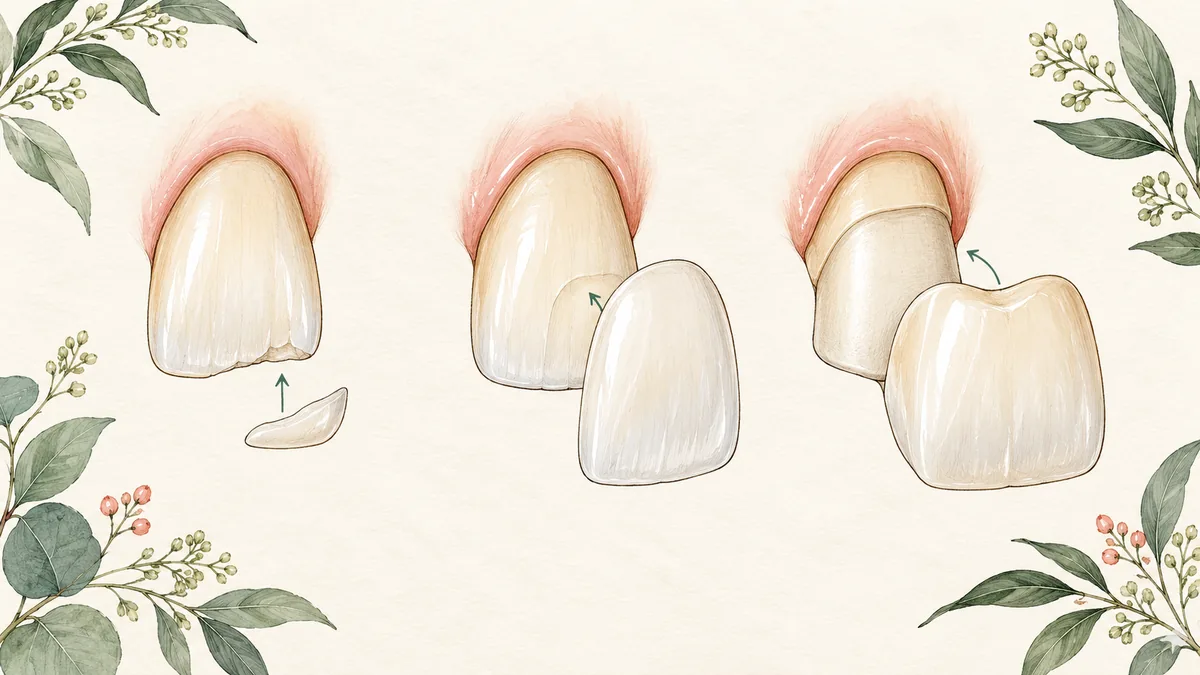
Many people are offered crowns or veneers when they ask for something simpler. Sometimes that is the right answer, and sometimes it is simply the treatment on the price list. This page sets out when composite bonding, which adds tooth-coloured resin to a tooth instead of removing tooth, is worth asking about, and where it falls short.
Our page on what composite bonding is explains the treatment; this one helps you compare it with the alternatives, such as veneers. The advice applies wherever you are treated and is not a case for or against any country.
What is the core trade-off?
Crowns and veneers are subtractive: a dentist reshapes the tooth so that a laboratory-made restoration can be fitted. Bonding is additive: resin is built on to the tooth directly, in the mouth. An NHS hospital patient leaflet on crowns is plain that a crown involves removing some tooth structure, and veneers usually remove some but not as much.3
The scale of the difference comes from a laboratory study using resin model teeth, not patients. In that study of front-tooth preparations, veneer and resin-bonded bridge-retainer preparations removed roughly 3% to 30% of the crown by weight, depending on the design, and crown preparations roughly 63% to 72%.2 Bonding was not one of the designs measured, so the figures show the range that conventional preparation covers, not how much bonding removes.
What the evidence does say about bonding is that direct composite resin veneers are usually less invasive of the tooth structure than indirect veneers, and easier to repair, while the preparation for indirect veneers is generally more invasive and those restorations are harder to repair.1 “Less invasive” is not the same as untouched. We found no published figure for how much a bonding procedure removes, so ask what, if anything, will be taken from each tooth.
In which cases can bonding achieve the goal?
Our sources give no checklist of who is a candidate; that judgement belongs to the dentist who examines you. A systematic review of front-tooth composites covered 17 studies and 1,821 restorations, including fillings on front teeth, veneers placed for appearance and restorations on worn teeth.5
For one group the case is explicit. A guide to managing tooth wear concludes that minimally invasive and adhesive restorative strategies are preferred when severe tooth wear is treated.6 The same guide says restorative treatment is not always needed, and that where a patient has no complaints, counselling and monitoring is probably the sensible option.
Useful questions for your dentist: is the tooth sound enough that the aim is only to change its shape, colour or edge, and what would you lose by trying bonding first?
In which cases does bonding not achieve it?
Bonding may fall short where much of a tooth has already gone. The NHS leaflet lists reasons a crown may be advised: a tooth weakened by a large filling or decay, tooth wear, or a root-filled tooth.3 Protecting what is left may matter more than leaving it unaltered.
That is the difference we draw on our tooth preparation page between a damaged tooth and a sound one.
Other limits follow from the material. The same review that finds composite less invasive also says it is susceptible to changes in surface gloss and to discolouration.1 If you want a result that looks unchanged for many years with little maintenance, the sources we found do not suggest bonding is the more reliable route.
Clenching and grinding are a problem for both. The tooth wear guide warns that restorations in people with severe wear from grinding or erosion may prove to have a limited lifetime.6 Tell any dentist if you grind your teeth.
How do the lifespans compare, honestly?
It is often said that bonding lasts less long than a crown or veneer (see also how long Turkey teeth last). The evidence we found does not support so tidy a statement. The figures below come from studies of different restorations and follow-up periods, so they show a range rather than a verdict.
For a rule of thumb, the NHS leaflet says a crown or veneer that is properly cared for should normally last around 8 to 10 years.3 That is a patient-information estimate, not a trial result, and it does not distinguish between crowns and veneers.
For composite veneers, a systematic review and meta-analysis of seven studies found pooled survival of 88% (95% confidence interval 81% to 94%) in its randomised trials, with mean follow-up between 24 and 97 months.4 Direct composite veneers showed higher survival than the indirect approach in that review. The commonest complications were surface roughness and colour changes, most of them clinically acceptable with or without further treatment. The evidence base is small and the follow-up short of a decade.
The broader picture is less tidy. In the review of front-tooth composites, total failure was 24.1%, annual failure ran from 0% to 4.1%, and survival ranged from 53.4% to 100%.5 Fracture was the commonest reason for failure, and for restorations placed for appearance it was colour, form and staining. That mixes several kinds of restoration, so it is not a figure for cosmetic bonding alone. It does show how much depends on the tooth and the case.
| Feature | Direct composite bonding | Veneers and crowns |
|---|---|---|
| Tooth removed | Usually less than for indirect restorations; no published figure found | Lab model: about 3% to 30% (veneer and bridge-retainer designs) and 63% to 72% (crown) |
| Can it be undone? | Largely: it adds to the tooth and usually removes less, though the enamel is etched, so other options usually stay open | No: tooth removed in preparation cannot be put back |
| Repair | Usually easier to repair | Indirect veneers are generally harder to repair |
| Common weak points | Surface gloss, discolouration, fracture | Grinding and clenching can make a crown unsuitable |
| Lifespan | No single reliable figure; wide ranges across studies | Around 8 to 10 years if well cared for (NHS hospital leaflet) |
Treatment comparison
How do these options differ?
In short, bonding trades some permanence for preservation. It may need repair more often, but a repair adds to the tooth, whereas replacing a crown means shaping it again, as our tooth preparation page explains.
What does cost look like over ten years?
One review describes direct composite veneers as usually more affordable than indirect ones.1 This page quotes no prices. Our cost pages show advertised starting prices for bonding, veneers and crowns in the UK and in Turkey, from our own survey of clinic and practice websites accessed October 2026, with what they include and leave out.
What we can offer is a way of comparing: look at the total over time, not the fee on the quote. Ask what each option includes, what repair is covered and for how long, what happens at the end of its life, and who does the follow-up.
How do you raise bonding with a clinic that only quotes crowns?
A clinic that quotes crowns is not necessarily wrong; your teeth may need them. The aim is to find out whether the quote is about your tooth or the package. The review of anterior veneers is blunt: decisions should rest on sound evidence, not marketing or testimonials.1
- Ask why each tooth needs a crown. The answer should be about the tooth, such as decay or a fracture, not the plan.
- Ask what bonding would involve for the same tooth, what would be removed, and what would make it unsuitable.
- Ask for bonding to be quoted in writing beside the crown.
- Ask who repairs it, and where. Repairs need a dentist to see you again.
- Take time. A decision about permanent tooth removal need not be made the day it is offered.
Our tooth preparation page has a longer list of questions. For the wider choice of options, return to the UK alternatives overview.
Frequently asked questions
-
Is composite bonding really less invasive than a veneer or crown?
Generally, yes. The evidence we found describes it as usually less invasive of the tooth than the indirect options, and laboratory work shows crown preparations removing roughly 2.4 to 4.3 times more tooth than veneer ones. “Less” is not “none”, so ask what will be done to each tooth. Our guide to tooth preparation covers the permanent part.
-
How long does composite bonding last?
We found no single reliable figure. Pooled trials of composite veneers reported 88% survival at a mean follow-up of between two and eight years, while a wider review of front-tooth composites found survival from 53.4% to 100%, depending on the study. Ask your dentist what to expect for your own teeth.
-
Is bonding cheaper than crowns or veneers?
Direct composite veneers are usually more affordable than indirect ones, according to one review. We quote no prices on this page; our cost pages show advertised starting prices for bonding, veneers and crowns in the UK and Turkey, from our own survey of clinic and practice websites. Compare the whole cost over time, including repairs and replacement.
-
Can I still have a veneer or crown later if I choose bonding?
Usually that option stays open, because bonding takes less from the tooth to begin with. It is the reverse that is not possible: tooth removed for a crown or veneer cannot be put back. Your dentist can tell you whether anything about your teeth changes that.
-
Does grinding or clenching affect bonding?
Yes. A guide to managing tooth wear warns that restorations in people with severe wear from grinding or acid erosion may have a limited lifetime, and that this should be explained when you consent. If you grind your teeth, raise it before any treatment and ask what protection is advised.