If you search for “Turkey teeth” before and after, you will find plenty of photographs and very little explanation. This page does two things: it explains why we publish none, and it shows you how to read the ones you meet elsewhere.
It is not an argument against treatment, and it is not a judgement on anyone who has had it. It is about what a photograph can and cannot tell you. For the treatments themselves, start with our guide to what “Turkey teeth” means.
Why don’t we publish a gallery?
We publish no gallery for five reasons. A gallery shows only what its publisher chose, company pictures are company literature, images spread faster than evidence, photos can shame as well as sell, and images of a person’s mouth and face are personal.
- A gallery shows what its publisher chose. We cannot see the cases left out, and we cannot verify who is pictured, when the photos were taken or what was done.
- Company pictures are company literature. The Foreign Office’s Turkey travel advice says that private companies have a financial interest in booking your treatment, and that their literature should not be your only source of information.2
- Images spread faster than evidence. The 2025 analysis of 131 UK newspaper articles on dental tourism concluded that viral social media health trends distributed information and misinformation alike.1
- Photos can shame as well as sell. The same analysis found that articles portrayed people as vain or foolish, and tabloids often stigmatised people who had treatment abroad.1 A gallery of poor results would risk doing the same.
- Privacy. A photograph of someone’s mouth and face is personal, and we cannot verify consent for an image sent to us.
We sell nothing and have no clinic to promote, so a gallery would do nothing for you. Where a picture helps, we use a schematic drawing instead.
What changes between two photos?
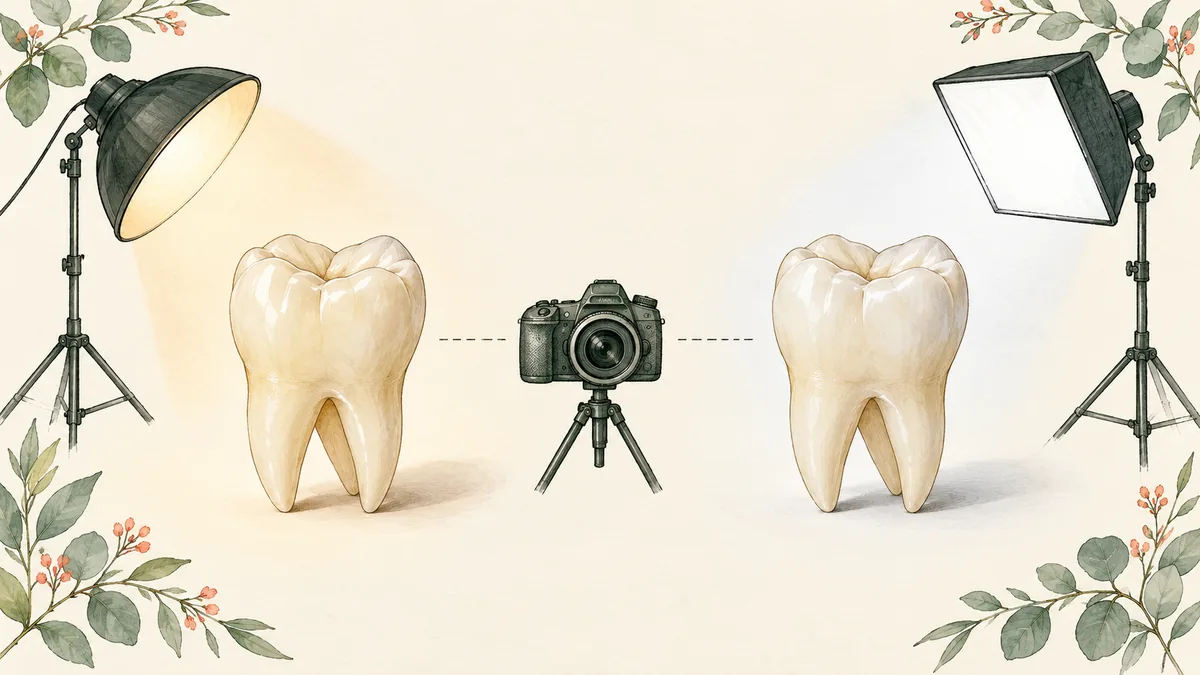
Two photographs of the same mouth can look like two different treatments. None of the changes below requires any dishonesty. They happen innocently when photos are taken on different days, on different phones and in different rooms. The table lists five factors: lighting, angle and distance, lip position, gum appearance and editing.
| Factor | What it can change | What to check |
|---|---|---|
| Lighting | How light, yellow or grey a tooth looks | Is the light the same in both? |
| Angle and distance | Apparent length, crowding and gaps | Same angle and same distance? |
| Lip and smile position | How many teeth and how much gum show | Same expression and lip position? |
| Gum appearance | Swollen or healed gums look very different | How long after treatment was it taken? |
| Colour and editing | Shade, smoothness and contrast | Any sign of a filter or retouching? |
That is the point of the table: a difference between two photographs is not the same as a difference in the teeth.
Reading photographs
Five things to compare before drawing a conclusion
- 01LightingLight changes the apparent shade.
- 02Angle and distancePerspective changes apparent length and gaps.
- 03Lip and smile positionExpression changes how much tooth shows.
- 04Gum appearanceHealing and swelling affect the frame.
- 05Colour and editingFilters alter shade, contrast and detail.
What can a photo not show?
A photograph shows the surface. The things that decide how a result lasts are mostly out of sight. Six stay hidden: the tooth underneath, the edge of the restoration, the bite, the gums, the nerve, and the plan behind the work.
- The tooth underneath. How much was removed, and whether it was sound to begin with.
- The edge. The line where the restoration meets the tooth, often at or under the gum, where a poor fit can let decay begin.
- The bite. How the teeth meet when you chew, which affects comfort and chipping.
- The gums. Inflammation or recession that may develop over time.
- The nerve. Whether the tooth is comfortable, sensitive or painful.
- The plan. The material, the laboratory, the X-rays, who treated you and what was promised.
A crown and a veneer can look alike on the surface, though they remove very different amounts of tooth; what “Turkey teeth” actually are explains the difference, and what is removed beneath the photo covers the part that cannot be undone. Results are judged over time. In the BDA survey of more than 1,000 UK dentists, 95% had examined patients treated abroad and 86% of those had treated complications.3 These are dentists’ reports about treatment abroad in general, not patient rates, and they do not single out Turkey.
What is the shade trap?
Wanting whiter teeth is a reasonable aim. The trap is deciding from a picture. A very bright, uniform shade looks striking on a screen, but natural teeth are not one flat colour: tone and translucency vary from the gum to the edge, and neighbouring teeth differ slightly.
A shade chosen from a photograph, a filter or a screen can look different in daylight, in a mirror and next to your own skin. Before anything permanent is done, ask:
- How is the shade chosen: against a shade guide, in person, in natural light?
- Can I see a trial or mock-up first?
- What would it take to change the shade later?
Our guide to crowns versus veneers compares what each treatment involves.
What difference does time make?
An “after” photo is usually taken when the work is at its newest, and problems with fit, gums, bite or wear, if they come, develop afterwards. We found no published study that follows treatment done in Turkey with photographs over several years, so no one can tell you what a typical two-year photo looks like.
TravelHealthPro advises getting a written contract and checking credentials independently, and notes that follow-up care may not be covered by the NHS.4 The NHS checklist lists a hard sell, pressure to decide quickly, no discussion of complications and no mention of aftercare as reasons to think carefully.5 If a clinic leads with photographs instead of a plan, ask for the plan.
If you see results, ask how long after treatment the “after” photo was taken, and whether the same patient was photographed later. If something feels wrong at any point, do not wait: contact your own dentist or NHS 111, and call 999 or go to A&E if it is hard to breathe, speak, swallow or open your mouth, or if there is a lot of swelling in your mouth, face or neck.
Which eight questions should you ask about any before-and-after?
Ask who is pictured and who took the photographs, when the “after” photo was taken, whether lighting and angle match, which teeth were treated and with what, how much tooth was removed, whether X-rays exist, whether the result is typical, and who treated the patient.
- Whose teeth are these, and who took the photographs?
- When was the “after” photo taken: days, months or years after treatment?
- Are lighting, angle and distance the same, and has either photo been edited or filtered?
- Which teeth were treated, and with what: crowns, veneers or bonding? If the caption does not say, the photo does not show what was done.
- How much tooth was removed, and was a less invasive option considered?
- Were X-rays taken before and after, and can I see them?
- Is this a typical result or a selected one, and what happened to patients who had problems?
- Who treated this patient, and will that same dentist treat me?
Vague answers, or a reluctance to put the plan in writing, are information in themselves. Our guide to advertising red flags covers what else to watch for in a clinic’s marketing.
Frequently asked questions
-
Are “Turkey teeth” before-and-after photos real?
We cannot verify any image, and we found no research on how often before-and-after photos are edited, filtered or selected, so we make no claim either way. Treat a single image as one data point, and use the questions on this page. Our Turkey teeth guide gives the wider picture.
-
Why do the teeth in these photos look so white?
Several things can make teeth look whiter in a picture: a bright shade chosen for the restorations, strong lighting, camera settings and filters, and a “before” photo taken in dimmer light. Ask which shade was chosen and whether you can see a trial first. Our guide to what they actually are explains the treatments.
-
What should I look for in a before-and-after photo?
Look first at what the caption leaves out: which teeth, which treatment, how long ago, and whether lighting and angle match. Then ask for the written plan and the X-rays behind the picture. Our guide to crowns versus veneers shows what a clear plan should state.
-
Why do you not publish a before-and-after gallery?
A gallery shows only what its publisher chose, we cannot verify who is pictured or what was done, and photographs of someone’s teeth and face are personal. We also sell nothing, so we have no reason to show results. The reasoning is at the top of this page, and our Turkey teeth guide covers the treatment itself.
-
Can a photo show whether someone has crowns or veneers?
Not reliably. Both cover the visible tooth, so the difference lies in what was removed underneath, which a photograph cannot show. Only the written plan, records and X-rays can say. Read what they actually are, and ask your own dentist to review the records if you are unsure.
-
Does a good photo mean a good dentist?
Not by itself. A photo captures a single day’s appearance, not the diagnosis, the plan, the fit beneath the gum or what happens afterwards. Look for a named dentist whose registration you have checked, a written plan and aftercare arrangements. Our guide to verifying a dentist explains how.