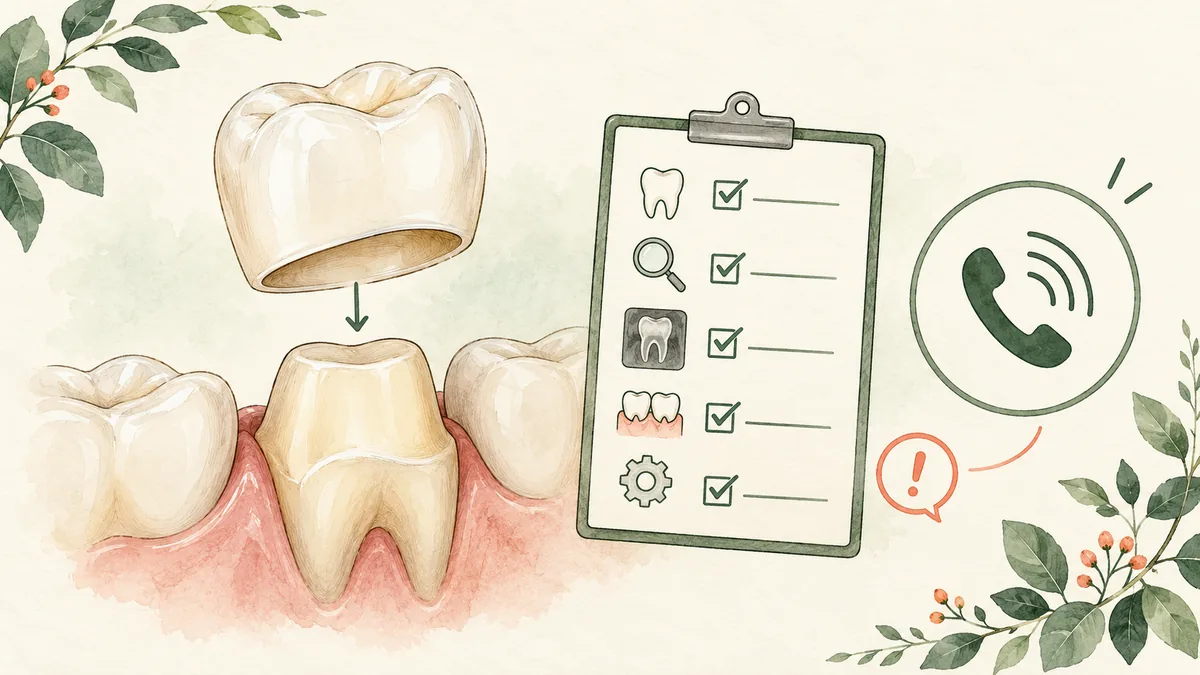
If something already feels wrong with dental work done abroad, read the box below and contact a dentist; the rest can wait. If you are reading before treatment, this page shows what UK dentists report, why it happens and what can be put right.
We found no reliable figure for how often Turkey teeth go wrong in Turkey specifically.
When to get help
- Your own dentist: toothache that lasts more than two days, a crown that has come off, or a tooth that hurts to bite on.
- Your dentist or NHS 111, the same day: swelling in the gum, cheek or jaw, a bad taste, or a high temperature.
- 999 or A&E: difficulty breathing, speaking, swallowing or opening your mouth; a lot of swelling in the mouth, face or neck; or a swollen or painful eye or sudden problems with your eyesight.
For who to call and what the NHS does and does not cover, read getting it dealt with at home.
Turkey teeth gone wrong: what do patients most often report?
The clearest verified picture comes from the BDA, and it reflects dentists’ reports, not patients’ outcomes. In its survey of more than 1,000 UK dentists, 95% had examined patients treated abroad and 86% of those had treated complications; crowns most often needed follow-up, closely followed by implants.1
Pain and sensitivity after treatment
Some people notice sensitivity to hot, cold or sweet food after a tooth is prepared; we found no reliable figure for how often. The NHS says to see a dentist if toothache lasts more than two days, does not go away with painkillers, or comes with a high temperature, pain on biting, red gums or a bad taste.3
Bite problems and how teeth meet
If new teeth meet unevenly, one may feel high or your jaw may ache after meals. We found no verified figure for how often. Pain on biting is one of the NHS warning signs, so have it checked rather than getting used to it.
Gum inflammation and recession around crowns
The edge of a crown or veneer usually sits near the gum line, so the way it is fitted can affect the gum. Look for red, swollen or bleeding gums, or a gum that has drawn back to show the edge of the restoration.
Crowns that come loose or fracture
A crown that comes off or a veneer that chips is the most visible problem, and a recognised urgent one: the NHS lists refixing crowns among its urgent treatments in England.5 A loose crown can mean a worn cement seal or decay underneath, and only a dentist can tell which.
Decay or infection under a crown
Decay can start under a restoration where you cannot see it, and if it reaches the nerve the tooth can become infected. The NHS says a dental abscess will not go away on its own and needs urgent treatment by a dentist.4
Nerve damage can also follow preparation itself. A systematic review of 37 studies found the pulp, the living centre of the tooth, died in about 5% of teeth after indirect restorations, which in the studies reviewed were mainly crowns and bridges, and the tissue around the root became diseased in about 3.6%.2 The authors rated the certainty low and concluded that incidence remains low overall; most teeth keep their nerve.
Appearance: shade, shape, bulk
Some complaints concern looks: teeth that seem too white, too uniform or too bulky, or different from what was agreed. Ask for your written plan and any shade records so you can compare what was agreed with what was delivered.
Why do these problems happen?
These problems arise at points where treatment can go wrong in any country: preparation, fit at the margin, clinic and laboratory communication, time for planning, and which teeth are treated. We found no data on how much each contributes, so they are not ranked.
- Preparation. The more tooth is removed, the less protects the nerve. The same review reported higher pulp risk on front teeth and where a temporary crown stayed on for more than two weeks, and one study in it found higher risk where the tooth already had decay or an existing filling or restoration.2 See why preparation cannot be undone.
- Fit at the margin. A crown that does not seal tightly at the edge can trap plaque or irritate the gum.
- Clinic and laboratory. A technician who has not seen your mouth usually makes the crown, so shade, shape and bite depend on clear records passing between them.
- Time for planning. A short stay leaves little room for assessment, temporary teeth, fitting and review. That reflects how a trip is arranged, not any one clinic.
- Which teeth are treated. A crown suits a broken or heavily filled tooth. On a healthy tooth, for looks alone, it brings every risk above without a health reason.
None of this means every clinic in Turkey cuts corners, or that UK dentists never do.
What is fixable, and what is not?
Many problems can be corrected. A badly fitting restoration can often be remade, a loose crown refixed once the tooth beneath is checked, and an infected nerve treated. For an abscess, the NHS describes draining the pus, root canal treatment or removal of the tooth, sometimes with antibiotics.4
| Problem | Can it be put right? | What it can involve |
|---|---|---|
| Loose crown or chipped veneer | Often | Refixing or remaking it |
| Uneven bite | Often | Adjusting or remaking the restoration |
| Sore or receding gums | Depends on cause | Cleaning, and a check of the edge |
| Decay under a crown | Depends on how far it has gone | Treating the tooth and replacing the crown |
| Infected or dead nerve | Treatable, but urgent | Root canal treatment, or removal of the tooth |
| Shade or shape you dislike | Sometimes | Remaking it, perhaps with further work on the tooth |
| Tooth structure already removed | No | Cannot be regenerated; only covered |
The table is a general guide, not a diagnosis.
If implants were part of your treatment, a Cambridge University Hospitals leaflet describes numbness after implant surgery as very rare.6 It also notes that inflammation of the gum around an implant (mucositis) or bone loss around it (peri-implantitis) can develop if implants are not cleaned properly.6
What should you do first if something feels wrong?
Deal with pain, swelling and fever before anything else. Call your own dentist for toothache, a dentist or NHS 111 the same day for swelling of the cheek or jaw, and 999 or A&E for the emergency signs in the table below.
| What you notice | Who to contact |
|---|---|
| Toothache lasting more than two days, or not eased by painkillers | Your own dentist |
| Pain on biting, red gums, a bad taste or a high temperature | Your dentist the same day if possible; NHS 111 if you cannot reach one |
| Swelling of the cheek or jaw | Your dentist or NHS 111 the same day |
| Difficulty breathing, speaking, swallowing or opening your mouth; a lot of swelling in the mouth, face or neck; a swollen or painful eye or sudden eyesight problems | 999 or A&E |
This follows the NHS guidance on toothache, which sends swelling that affects breathing, swallowing or speaking to A&E.3 The NHS abscess page adds that a GP cannot provide dental treatment, so a dentist or NHS 111 is the right first call.4
Then gather what you can for your dentist:
- The written plan, quote and messages about what was agreed.
- Material and laboratory names, and X-rays or scans requested from the clinic in writing.
- Dated photographs and notes of symptoms, plus any crown that has come off.
Tell your UK dentist the full story.
Going back to Turkey, or getting it sorted at home?
Travelling with pain, swelling or infection is a poor idea, and a UK dentist may be able to act at once, although they may be cautious about taking over work they did not plan. Check whether your guarantee covers only work done by the clinic that placed the crown, since claiming could then mean flights and time off.
In the BDA survey, just over 40% of the dentists who responded said the remedial treatment was provided on the NHS, so NHS dentists do take on part of it.1 See NHS care and emergencies at home for urgent routes; NHS charges differ across the four UK nations (see our page explaining NHS dental charges).
What does it cost to put right?
We found no reliable average cost for correcting treatment done abroad, and we do not invent one. The bill depends on how many teeth are involved, whether nerve treatment or extractions are needed, and whether you are treated on the NHS or privately. The figures are on our page about what it costs to put dental work right.
In the BDA survey, over half of the dentists reported repair costs above the survey’s middle band, and one in five of those reported the highest band.1 The cost section covers comparing quotes.
What are your options for complaints and redress?
This is information, not legal advice. The route usually starts with the clinic, so keep everything in writing.
- Write to the clinic. State the problem factually, attach photographs or a dentist’s findings, and say what you want: remaking the work, a refund or a contribution to treatment elsewhere.
- Check the contract and guarantee. Look for time limits, who pays for travel, and whether work by another dentist affects cover. Our guide to guarantees and redress explains what to look for.
- Ask your UK dentist for a written assessment.
- Get independent advice. We found no reliable source on how UK consumer law applies when the clinic is in Turkey, so we do not guess. An adviser or solicitor can say what applies to your contract and how you paid.
The General Dental Council regulates dental professionals in the UK; it says it cannot guarantee a similar body exists abroad (see how to verify a dentist).
How can you lower the risk if you still decide to go?
Treatment abroad does not always go wrong, and the decision is yours. These steps guarantee nothing, but they put you in a stronger position.
- See your own dentist before you book, and tell them your plans.
- Ask which teeth will be treated, why each needs a crown or veneer, and how much of each will be removed.
- Ask whether X-rays were taken and whether decay or gum disease will be treated first.
- Get a written plan naming the teeth, materials, guarantee and what happens if something fails.
- Do not agree to anything under time pressure, and book a UK check-up for your return.
To check credentials, read verifying a dentist. For context, see all the risks worth understanding and Turkey teeth explained.
Frequently asked questions
-
What are the most common problems after dental work in Turkey?
We found no reliable figures for treatment in Turkey specifically. UK dentists describe pain and sensitivity, an uneven bite, sore or receding gums, crowns that loosen or fracture, and decay or infection underneath. Some can trace back to how the tooth was prepared, so read why tooth preparation cannot be undone before deciding.
-
Can bad crowns be replaced?
Often, yes. A crown that fits badly, looks wrong or has decay beneath it can usually be removed and remade, although the tooth underneath may need treatment first. Each replacement is done on a tooth already prepared, so there is rarely more tooth to give. See tooth preparation for the limits.
-
Will the NHS fix them?
The NHS deals with urgent problems such as pain, infection and a crown that has come off, and charges apply. If you want cosmetic work redone, ask your dentist whether it can be done on the NHS or only privately, and what it would involve. Our guide to NHS care and emergencies at home explains how it works.
-
Do I have to go back to Turkey under the guarantee?
It depends on the wording. Check whether your guarantee covers only work done by the clinic that placed the crown, and whether it attaches conditions such as regular check-ups. We found no source for typical terms, so read yours and ask for them in writing. See what it costs to put right for how that can shape your decision.
-
Who do I contact if I’m in pain now?
Start with your own dentist. If you cannot reach one, NHS 111 can advise and help you find an emergency dentist. Call 999 or go to A&E if it is hard to breathe, speak, swallow or open your mouth, if your mouth, face or neck is very swollen, or if an eye is swollen or painful or your sight suddenly changes. Each route is explained in getting it dealt with at home.