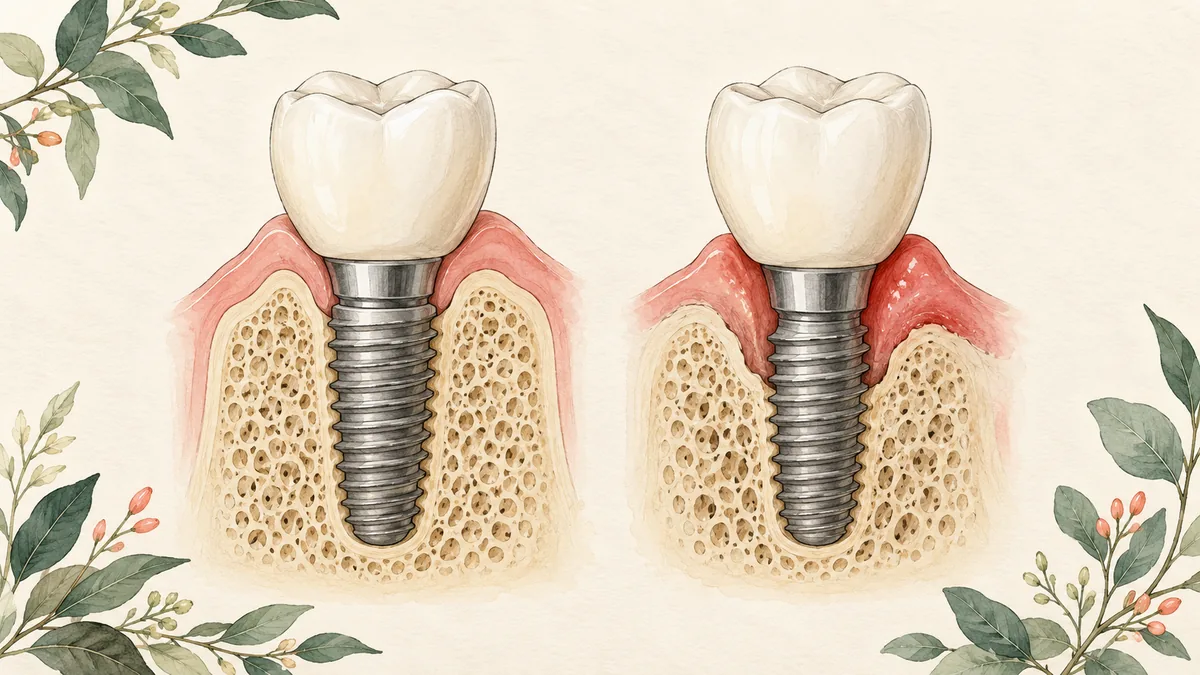
A dental implant is a screw-like post placed in the jaw to hold a crown, bridge or denture, and most implants keep working for many years. This page is about the minority that do not, particularly if the implant was placed abroad and you are now at home.
For the treatment itself, see our guide to dental implants, and for full-arch bridges, All-on-4. Our overview of other risks of dental treatment puts implant failure in context.
Early and late failure: how common is each?
Dentists usually separate failure into two kinds. Early failure happens during healing, when the implant does not bond to the jaw bone. The Cambridge hospital leaflet2 says healing usually takes three to six months, sometimes longer, and that over 90% of implants bond successfully.
Late failure happens after the implant has bonded and been in use, and the causes covered below include inflammation around the implant and overloading.
For the long run, a systematic review and sensitivity meta-analysis of 18 studies1 found 10-year implant survival of 96.4% (95% confidence interval 95.2% to 97.5%). When the authors allowed for people who were lost to follow-up, the figure fell to 93.2% (90.1% to 95.8%), and survival was lower, at 91.5%, in people aged 65 and over. The hospital leaflet2 gives a wider range, 80% to 95% over 15 years, for people with healthy mouths.
| Source | What was measured | Result | Caveat |
|---|---|---|---|
| Pooled analysis, 18 studies | Implant-level survival at 10 years | 96.4%; 93.2% allowing for loss to follow-up | Mixed studies, not specific to any country |
| NHS hospital leaflet | Success over 15 years, healthy mouths | 80% to 95% | Patient information, not a study |
These figures describe implants placed in many countries. We found no reliable published failure rate for implants placed in Turkey, and no figure can tell you how your own implant will do.
What are the signs that an implant is failing?
We did not find a national NHS page that lists them for implants, so treat this as a prompt to get checked, not a way to diagnose yourself. The signs include looseness, pain that is not settling, red, swollen or bleeding gum, pus or a bad taste, receding gum and a changed bite.
- The implant, or the whole bridge it supports, feels loose or moves when you press or bite.
- Pain or tenderness that is not settling, or is getting worse.
- Gum around the implant that is red, swollen or bleeds.
- Pus, a bad taste or a persistent bad smell near the implant.
- Gum drawing back so that metal shows.
- A bite that feels different from how it did at the end of treatment.
Some of these also occur when only the crown, or a small screw beneath it, has worked loose. Only a dentist can say which you have. Swelling, a fever or difficulty opening your mouth can be more urgent; our page on infection and nerve damage explains those warning signs.
When to get help
- Your own dentist: a loose implant or bridge, pain, bleeding or discharge around an implant.
- NHS 111: if you cannot reach a dentist and the problem is urgent.
- 999 or A&E: difficulty breathing, speaking, swallowing or opening your mouth; a lot of swelling in the mouth, face or neck; or a swollen or painful eye or sudden problems with your eyesight.
What the NHS will and will not do is set out in NHS care and emergencies at home. For when treatment abroad goes badly more generally, see when “Turkey teeth” go wrong.
Why do dental implants fail?
Reported risk factors for implant failure, or for inflammation around the implant, include smoking, diabetes, a history of gum disease, a lack of regular preventive care and grinding (bruxism). The reviews we found describe associations, not proven causes, and the table below summarises them.
Smoking
A meta-analysis of 107 studies3 found 1,259 failures among 19,836 implants in smokers (6.35%) and 1,923 among 60,464 implants in non-smokers (3.18%). The authors cautioned that uncontrolled confounding limits what can be concluded. The hospital leaflet2 is firm about it and expects smokers to stop at least six months before treatment.
Gum disease, diabetes and maintenance
A systematic review of 57 studies4 identified smoking (odds ratio 1.7), diabetes (2.5), a history of gum disease and a lack of regular preventive care as risk factors for peri-implantitis. Age, sex and implants in the upper jaw were not related. Its outcome was inflammation around the implant, not implant loss, so read these figures as a guide to gum and bone health.
Grinding and overloading
A meta-analysis of 27 studies6 found 138 failures among 2,105 implants in probable bruxers (people who grind or clench) and 352 among 10,264 implants in non-bruxers, an odds ratio of 2.19 (95% confidence interval 1.34 to 3.58).
| Factor | Outcome studied | What the review found | Caution |
|---|---|---|---|
| Smoking | Implant failure | 6.35% of implants in smokers, 3.18% in non-smokers | Authors warn of uncontrolled confounding |
| Smoking | Peri-implantitis | Odds ratio 1.7 | Association, not proof of cause |
| Diabetes | Peri-implantitis | Odds ratio 2.5 | Outcome is gum and bone inflammation, not implant loss |
| Grinding (bruxism) | Implant failure | Odds ratio 2.19 | Probable bruxism, assessed differently across studies |
| No regular maintenance | Peri-implantitis | Median prevalence 18.8%, against 9.0% with maintenance | Gap disappeared after adjusting for study size; still listed as a risk factor |
What is peri-implantitis?
Peri-implantitis is inflammation around an implant with loss of the bone that supports it. The Cambridge leaflet2 warns that inflammation of the gum around an implant (mucositis) or bone loss around it (peri-implantitis) can develop if implants are not cleaned properly, and advises reviews every three to six months.
How common it is depends heavily on how it is defined. The Dreyer review4 found estimates ranging from 1.1% to 85.0% between studies, with a median of 9.0% where people attended a regular maintenance programme and 18.8% where they did not (this gap disappeared after adjusting for study size, but the review still identified lack of regular maintenance as a risk factor). Treat any single percentage with caution.
What can be done when an implant fails?
What happens depends on how early the problem is found and what is behind it. Typical steps are cleaning and treating the infection around the implant, removing the implant if it cannot be saved, and then deciding with your dentist whether to place another, use a different kind of restoration or leave the gap.
The evidence for treating peri-implantitis is weak. A Cochrane review of nine trials5 found no reliable evidence on which treatments are more effective, and none of the trials was at low risk of bias. The review was last searched in 2011, so newer research may exist. The practical lesson is to be seen early when something changes.
Finding someone to assess and treat an implant placed elsewhere is covered in finding a UK dentist after treatment abroad.
What if an implant fails after you return?
Start with your own dentist, or the dentist who has taken over your care, and bring your treatment record and X-rays if you have them. If there is swelling, fever or pain that is spreading, NHS care and emergencies at home explains who to call.
Also tell the clinic that placed the implant, since what it will do about the problem depends on the terms you were given; guarantees and redress explains what to check.
Frequently asked questions
-
What are the signs that a dental implant is failing?
Common signs are an implant that feels loose, pain that is not settling, red or bleeding gum around it, pus or a bad taste, and gum drawing back. A loose crown is not always a loose implant, and only a dentist can tell the difference. Our page on infection and nerve damage covers the signs that need same-day help.
-
How common is dental implant failure?
In one pooled analysis of 18 studies, about 96% of implants were still working at ten years, or about 93% when people lost to follow-up were allowed for. We found no reliable failure rate for Turkey specifically, so we do not quote one. Our guide to dental implants sets out the wider picture.
-
Does smoking make implants more likely to fail?
In a meta-analysis of 107 studies, implants in smokers failed more often, at 6.35% against 3.18% in non-smokers, although the authors warned that other factors may explain part of the difference. One hospital leaflet expects smokers to stop at least six months before treatment. Your dentist can advise on your own risk.
-
Can a failed implant be replaced?
Sometimes, but it depends on why the first one failed and how much healthy bone remains, which only a dentist who has examined you can judge. Ask for an X-ray and a written explanation of the cause. Our page on finding a dentist after treatment abroad explains how to get an assessment.
-
Who do I call if my implant fails after I am home?
Call your own dentist, or NHS 111 if you cannot reach one. Call 999 or go to A&E if it is hard to breathe, speak, swallow or open your mouth, if your mouth, face or neck is very swollen, or if an eye is swollen or painful or your sight suddenly changes. See our NHS care and emergencies guide.
-
Will the clinic that placed the implant put it right?
That depends on the guarantee or terms you were given, which you should read before treatment and keep with your records. Guarantees often come with conditions, so ask for them in writing. Our page on guarantees and redress explains what to check; it is not legal advice.