Almost everything else on this site comes back to one fact: when a dentist prepares a tooth for a crown or veneer, the tooth structure that is removed does not come back. It is the starting point for understanding the main risks of treatment abroad.
What does “tooth preparation” mean?
Preparation is the stage in which a dentist uses a drill to remove enamel, and sometimes dentine, so that a restoration has room to sit and bond. The NHS guidance on dental treatments says that to fit a crown, the old tooth needs to be shaped for the crown to be fixed on to.3
For a veneer, the same guidance says the front of the tooth is drilled away a little, although not all veneers need this.3
For a veneer
A veneer is a thin shell that covers the visible front of a tooth. Preparation normally removes a thin layer of enamel from that surface, and sometimes from the biting edge. Designs marketed as “minimal-prep” or “no-prep” describe an intention rather than a measured amount, so ask what, specifically, will be taken from each tooth.
For a full-coverage crown
A crown surrounds the whole visible tooth, so preparation reduces it all the way round, at the front, back, sides and biting surface, to a smaller tapered core. There is far less tooth left afterwards than with a veneer, which is why crowns are the more consequential choice when the tooth underneath is healthy. See what Turkey teeth actually are for how this applies.
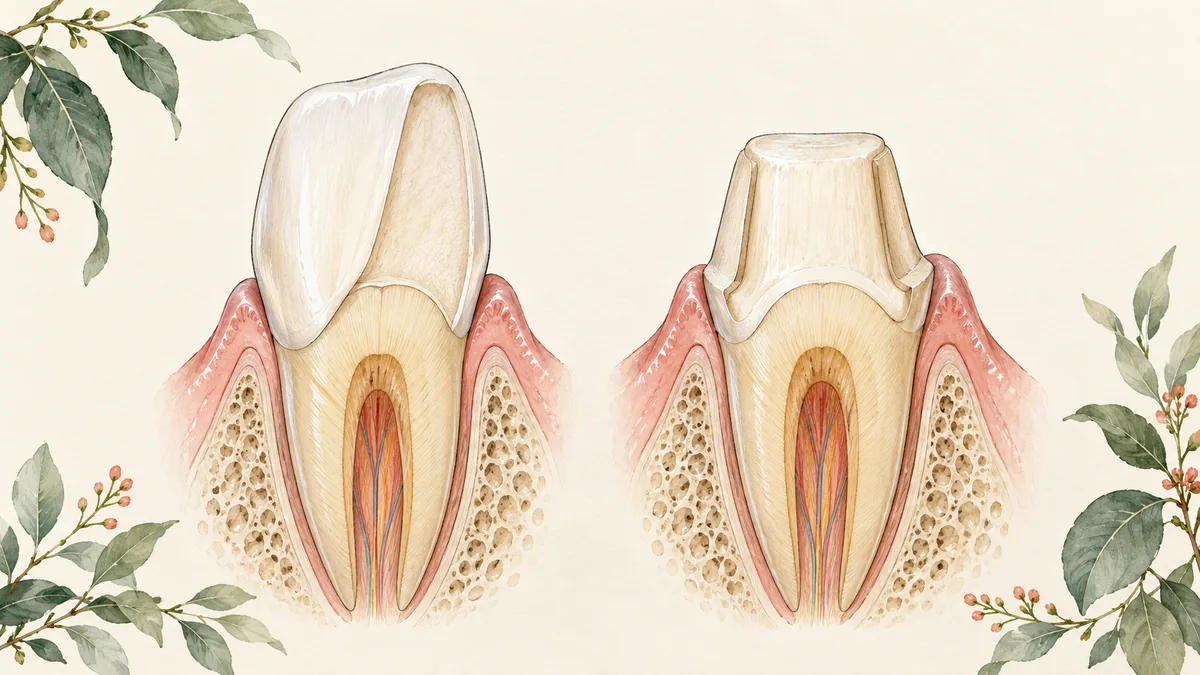
Tooth structure
A front tooth prepared for a veneer or crown
Veneer preparation

Mainly the front surface; the extent varies with the design.
Full crown preparation

The visible tooth is reduced all the way round.
The most widely cited measurements come from a laboratory study that used resin model teeth rather than patients. In that Journal of Prosthetic Dentistry study, veneer and resin-bonded bridge-retainer preparations on front teeth removed roughly 3% to 30% of the crown by weight, depending on the design, while crown preparations removed roughly 63% to 72%.2 The metal-ceramic crown preparation removed about four times as much as a traditional front-surface veneer, and about 2.4 times as much as the most extensive veneer design.
Real teeth vary, but in that model a full crown took roughly 2.4 to 4.3 times as much tooth as a veneer. See crowns versus veneers.
| Feature | Veneer | Full crown |
|---|---|---|
| Surface prepared | Front of the tooth, sometimes the biting edge | All the way round the visible tooth |
| Tooth removed, lab model of front teeth | About 3% to 30% by weight (veneer and bridge-retainer designs) | About 63% to 72% by weight |
| Reversible? | No — tooth preparation is permanent | No — tooth preparation is permanent |
Why is tooth preparation irreversible?
Enamel is the hard outer layer of the tooth. The cells that build it, called ameloblasts, are lost once the tooth has finished forming, which is why a review of tooth repair and regeneration research states that damaged enamel cannot be biologically regenerated.1 Enamel removed during preparation therefore stays gone.
What the mouth can do is re-mineralise weakened enamel with the help of fluoride and calcium phosphate. That repairs the surface; it does not rebuild thickness that has been drilled away.
Three practical consequences follow:
- A veneer or crown covers what is left of the tooth. It does not put back what was removed.
- A prepared tooth always needs some form of restoration afterwards, because it is no longer protected by the enamel it had.
- Changing your mind later means another restoration, not a return to the original tooth.
When to get help
- Your own dentist: pain that keeps you awake, or a tooth that is sore to bite on.
- Your dentist or NHS 111, the same day: a swelling in the gum or face, a bad taste, or a fever.
- 999 or A&E: difficulty breathing, speaking, swallowing or opening your mouth; a lot of swelling in the mouth, face or neck; or a swollen or painful eye or sudden problems with your eyesight.
Our guide to NHS care and emergencies at home, listed at the end of this page, has the full picture.
What can follow preparation on a healthy tooth?
A healthy tooth can be put at risk by the treatment itself in four ways: sensitivity, pulp irritation that may lead to root canal treatment, decay beneath the restoration at the margin, and changes to the gum such as inflammation or recession. We only quote figures found in the published evidence.
Sensitivity
Some people notice sensitivity to hot, cold or sweet food for a while after preparation. We found no reliable published figure for how often, so we do not quote one. If it does not settle, or is severe, go back to your dentist.
Pulp irritation and root canal treatment
The pulp is the living centre of the tooth, holding its nerve and blood supply. A systematic review and meta-analysis of 37 studies found that the pulp died in about 5% of teeth after indirect restorations, which in the studies reviewed were mainly crowns and bridges, and that the area around the root became diseased in about 3.6%.4 The authors rated the certainty of the evidence as low and concluded that the incidence remains low overall.
The risk was higher on front teeth and where a temporary crown stayed in place for more than two weeks, and one study in the review found it higher where the tooth already had decay or an existing filling or restoration. A tooth whose pulp has died usually needs root canal treatment, and sometimes removal.
Margin problems and decay beneath a crown
A crown or veneer meets the tooth at an edge called the margin. If the fit is poor, or the margin lies under the gum where it is hard to clean, plaque can collect there and decay can start beneath the restoration, out of sight. We found no figure specific to prepared healthy teeth, so we give none.
Gum response and recession over time
Because the margin usually sits at the gum line, how it is placed and finished affects the gum. Some people develop inflammation, or find that the gum draws back over the years, which can expose the edge of the restoration or the root surface.
The replacement cycle: what happens when a crown needs replacing?
Restorations do not last forever, and every replacement happens on a tooth that has already been prepared. When a crown is replaced, the tooth beneath is usually prepared again, so there is rarely more tooth to give. Because a crown is not permanent, a younger person may face more replacements over a lifetime.
A large analysis of NHS dental claims in England and Wales, covering ten million restorations, found that crowns outlasted fillings, but that teeth with crowns were more likely to end up extracted, particularly in younger patients.5 The data describe NHS patients between 1990 and 2006 and measure time to further treatment or extraction, not appearance, so they cannot tell you how a particular cosmetic crown will perform.
The NHS data show worse outcomes for younger patients in time to extraction. See how long Turkey teeth last for lifespan evidence, and if work has already failed, see when “Turkey teeth” go wrong.
When is tooth preparation clinically justified?
Sometimes the crown is the right treatment. The NHS notes that crowns can be fitted where a tooth has broken, decayed or been damaged, or just to make a tooth look better.3 When a tooth is damaged, the choice is between a damaged tooth and a protected one.
Where a tooth is broken, heavily filled, badly worn or has had root canal treatment, the choice is not between a healthy tooth and a prepared one. That is a very different situation from preparing sound teeth for appearance alone. The question to hold on to is whether the tooth needs the crown, or whether the crown is simply what is on offer.
Which additive alternatives remove little or nothing?
Composite bonding builds up the tooth with tooth-coloured resin instead of cutting it away. An evidence-based review of anterior veneers in the Journal of Adhesive Dentistry describes direct composite veneers as usually less invasive and easier to repair than indirect ones, though prone to discolouration.6
The trade-off is durability and upkeep rather than irreversibility. Bonding does not suit every smile, but it should be considered before anything is drilled. Read more about composite bonding as an additive option, and see bonding instead of crowns for when it can replace a crown.
What should you ask before anyone picks up a drill?
Before treatment, ask which teeth, how much is removed, why a crown rather than a veneer or bonding, whether there is a written plan and X-rays, and who looks after you afterwards. Vague answers, or a plan that will not be put in writing, are information in themselves.
- How many teeth, and which ones? Ask for each tooth to be named, not for a “full set”.
- How much of each tooth will be removed? Ask for it to be explained, with the design (veneer or crown) for each tooth.
- Why a crown rather than a veneer, or bonding? The reason should be about the tooth, not the package.
- Is there a written treatment plan? It should list the teeth, materials, visits and what happens if something fails.
- Have X-rays been taken? A plan made without imaging cannot account for decay, fillings or the state of the nerve.
- Who will treat me, and who looks after me afterwards? Aftercare is covered in our guide to what happens when you fly home.
If you are considering treatment in Turkey, our guide to what “Turkey teeth” involves sets these questions in context.
Frequently asked questions
-
How much tooth is shaved down for veneers?
In one laboratory study of front teeth, veneer and resin-bonded bridge-retainer preparations removed roughly 3% to 30% of the crown by weight, against roughly 63% to 72% for full crowns. No figure can tell you what will happen to your own teeth, so ask for it in writing. See our comparison of crowns and veneers.
-
Is tooth preparation reversible?
No. Enamel cannot regenerate once it has been removed, and a prepared tooth always needs some kind of restoration afterwards. A veneer or crown covers what is left; it does not replace what was taken away. Weigh that before treatment, and read what can go wrong with Turkey teeth if you are already worried.
-
Will I need root canal treatment afterwards?
Usually not. A pooled analysis of 37 studies found the nerve died in about 5% of teeth after indirect restorations, which in the studies reviewed were mainly crowns and bridges, though the evidence was rated low certainty. If pain or swelling persists, see your dentist; our guide to NHS care and emergencies explains who to call.
-
Can I have veneers without any tooth removal?
Some veneer designs involve little or no drilling, and the NHS notes that not all veneers need the front of the tooth to be drilled away. Whether that suits you depends on the position, shape and colour of your teeth, and a dentist has to assess it. Our guide to crowns versus veneers explains how the options differ.
-
What happens when a crown needs replacing?
The old crown is removed and the tooth beneath is prepared again, so there is rarely more tooth to give. Large NHS records show crowns last longer than fillings before needing further treatment, but teeth with crowns, particularly in younger patients, were more likely to be extracted. Ask about the replacement plan before the first crown goes on.