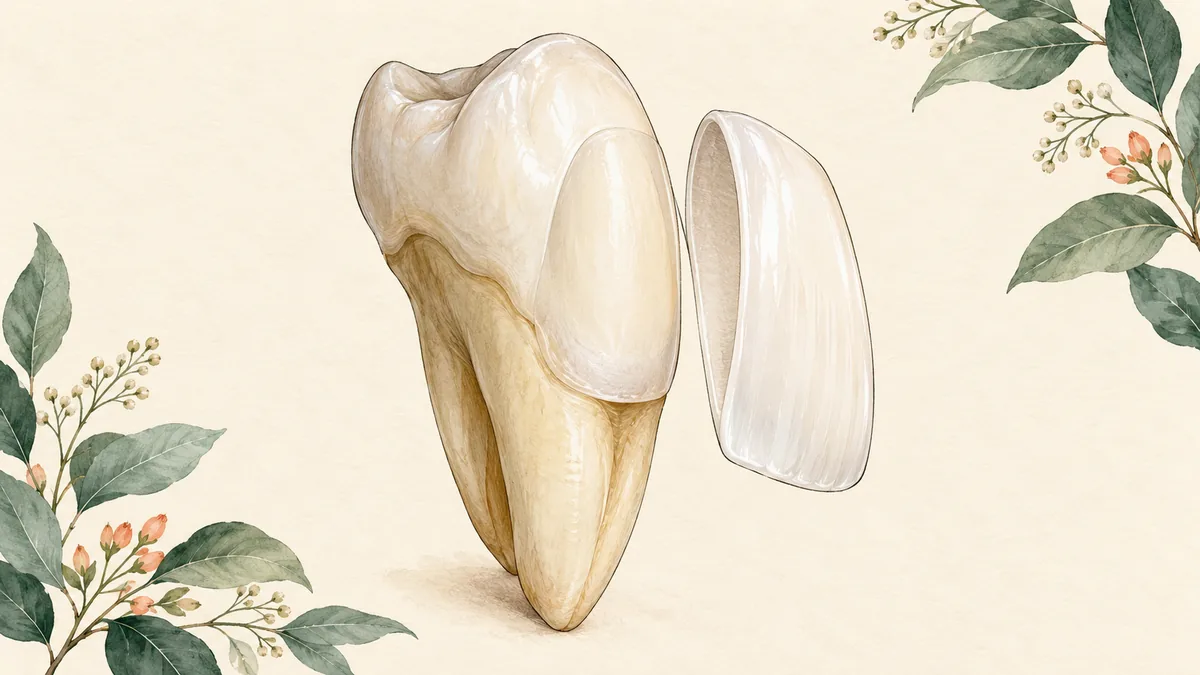
If you are asking what veneers are, the short answer is that they are a cosmetic covering for the front of a tooth. The longer answer depends on how much of your own tooth is removed to make room for one, because that part is permanent.
This page, part of our guide to cosmetic treatments, explains how veneers work, how much enamel different designs take, how long studies say they last, and what to check if you are quoted for them abroad. It is not an argument against veneers, and it recommends no dentist or clinic. If you are researching “Turkey teeth”, our page on what they actually are sets the term in context.
What are veneers, exactly?
A veneer is a thin shell, made of ceramic (often called porcelain) or composite resin, that is bonded over the visible front surface of a tooth. Dentists use them to change the colour, shape or length of a tooth, to close small gaps and to cover chips or wear. There are two broad kinds.
- Indirect veneers are made in a dental laboratory from ceramic and bonded to the tooth at a later appointment.
- Direct veneers are built up from composite resin on the tooth itself, with no laboratory stage. That route is covered in our guide to composite bonding.
A veneer covers the front of the tooth, while a crown surrounds it. That single difference decides how much of the tooth has to be shaped, and it is why the two terms matter when you read a quote. Our comparison of crowns versus veneers sets them side by side.
How much enamel is removed for a veneer?
It depends on the design and on your tooth. The NHS guidance on dental treatments says that for a veneer the front of the tooth is drilled away a little, although not all veneers need this.1 Laboratory work suggests veneers need less reduction than crowns, but real teeth differ and no single figure applies to every design.
The best-known measurements come from a laboratory study on resin model teeth, not patients. In that study of front teeth, veneer and resin-bonded bridge-retainer preparations removed roughly 3% to 30% of the crown by weight, and a metal-ceramic crown preparation removed 4.3 times as much as a facial-only veneer.2 The authors concluded that veneers needed about a quarter to a half of the reduction that complete-coverage crowns did.
Real teeth differ from resin models, so these percentages show an order of magnitude and not a promise about your own teeth. We do not quote a depth in millimetres, because we found no reliable figure that applies to every design.
Labels such as “minimal-prep” and “no-prep” describe an intention, not a measured amount. Ask for the amount to be explained for each tooth before you agree to anything, and read our page on tooth preparation for what follows when enamel has gone.
What are veneers made from?
Most indirect veneers are ceramic, while direct veneers are built from composite resin. The ceramics differ in how they are made and how they behave over time. The names you will see in quotes are feldspathic porcelain, glass-ceramics (including lithium disilicate, often sold as E-max) and zirconia.
A 2025 review of 29 studies found similar ten-year survival across ceramics but different complications: at 10.4 years, technical complications were estimated at 41.48% for feldspathic veneers and 6.1% for lithium disilicate.4 The same review found full survival for zirconia veneers at 2.6 years, but noted that there are no long-term data.4
Composite has its own trade-offs. For the wider material picture, see our guide to veneer and crown materials.
Who do veneers suit, and who do they not suit?
Veneers usually suit teeth that are structurally sound where the aim is cosmetic: stained, chipped, worn, slightly misshapen or gapped teeth. For the right tooth, a veneer is a more conservative choice than a crown. They are less likely to suit the following.
- Teeth with large fillings, extensive decay or heavy wear, where a crown may be the right treatment.
- Mouths with untreated gum disease or active decay, which should be dealt with first.
- People who clench or grind their teeth.
On grinding, a small study of 323 veneers in 70 patients found that of 13 fractures and 29 debonded veneers, 8 and 22 were in patients with bruxism, and that wearing an occlusal splint reduced fractures.6 It was a small study, but it is a reason to tell your dentist if you grind.
Whether veneers suit you is a judgement for a dentist who has examined your mouth and seen X-rays.
Veneers or crowns: what is the difference?
The difference is coverage, and coverage sets the cost to the tooth. A veneer covers the front, whereas a crown covers every visible surface, so the tooth is reduced all the way round. That is why a crown on a healthy tooth is the more consequential decision, and why a quote should say which is planned for each tooth.
Read crowns versus veneers for when each is justified. Where an additive option such as bonding could do the job instead of a crown, it may be worth considering first.
How long do veneers last, and how do you look after them?
There is no honest single answer, because it depends on the material, the dentist, your bite and how the veneers are cared for. What studies can tell you is how many veneers were still in service after a given time. “Survival” in these studies generally means the veneer was still in the mouth, not that it never needed repair.
| Study | What was followed | Result | Caveat |
|---|---|---|---|
| Pooled analysis, 13 studies3 | Feldspathic and glass-ceramic laminate veneers | 89% survival at a median of 9 years | Could not test whether the amount of tooth prepared changed the result |
| Pooled analysis, 29 studies4 | Ceramic veneers, by material | About 94% to 97% at 10.4 years across the three main ceramics | Complications far commoner with feldspathic; zirconia lacks long-term data |
| One dentist, 499 veneers5 | Feldspathic veneers, 155 patients, 1990 to 2010 | 96% at 10 and 20 years in a random one-per-patient sample | One expert operator; likely a best case |
Three cautions apply to every figure. First, these are mostly studies of ceramic veneers placed by experienced operators, and we found no verified outcome data specific to veneers in Turkey. Second, in the 13-study analysis, fracture or chipping was the most frequent complication at 4%, followed by debonding, severe marginal discolouration and problems with the nerve of the tooth (each 2%).3 Third, the 20-year series excluded molars and nerve-dead teeth, its preparations kept at least 80% enamel, and 75 veneers had an unknown outcome, so its authors’ results should be read as a best case.5
Looking after veneers is largely looking after your teeth: thorough cleaning at the gum line, regular check-ups so small problems are found early, and telling your dentist if you grind so that a night-time splint can be considered. A veneer will eventually need replacing, on a tooth that has already been prepared, so ask what the plan would be before you start.
What are “snap-on” and clip-in veneers?
Snap-on veneers, also sold as clip-in or removable veneers, are cosmetic covers made from a mould of your teeth that you put on and take off yourself. They are generally sold as a cosmetic product rather than as a dental treatment, and they are not bonded to the tooth in the way a dentist-fitted veneer is.
We did not find peer-reviewed evidence we can cite on how well they perform, how long they last, or what they do to the teeth and gums beneath, so we make no claims about any of those. If one is offered, ask whether your teeth and gums have been examined first and who you would see if it caused problems. They should not be compared like for like with a fitted veneer.
Veneers in Turkey: what should you check?
We found no verified outcome data specific to veneers in Turkey, and treatment there varies as it does anywhere. What is particular to treatment abroad is the quote: the word “veneer” is sometimes used loosely, and a plan for many teeth at once should say exactly what each tooth will receive. These checks help:
- Is each tooth to receive a veneer or a crown? Ask for it by tooth, not as a total.
- Which material will be used, and which laboratory makes the restorations?
- How much of each tooth will be removed, and was bonding considered first?
- Have X-rays been taken, and will decay and gum health be dealt with before anything is fitted?
- Is there a trial or temporary stage, so you can judge the shape before it is fixed?
- What happens if a veneer chips or comes off after you are home, and who pays?
Our guide to verifying a dentist and clinic explains how to check who will actually treat you. If something goes wrong once you are home, start with your own dentist.
What do veneers cost?
We do not quote prices on this page. Prices for veneers in Turkey, in UK private practice and on the NHS sit in our cost section, with the date each figure was checked. On the NHS, veneers are generally only available privately, unless you can show a clinical need.1
The principle to keep in mind is that price depends on the material, the number of teeth, the laboratory and the dentist’s time, so one quote is only comparable with another if it names the same design for the same teeth.
Frequently asked questions
-
Are veneers permanent?
A veneer is not permanent, but removing enamel to fit one is. Veneers can chip, wear or come loose and eventually need replacing, and each replacement is done on a tooth that has already been prepared. Read our guide to tooth preparation before you decide, and look at composite bonding, which takes little or no tooth.
-
Do veneers damage your teeth?
Fitting a veneer usually means removing some healthy enamel, and that cannot be undone. In one pooled analysis of 13 studies, problems with the nerve of the tooth affected about 2% of ceramic veneers. Damage is not inevitable, but it is a trade-off. See crowns versus veneers for how the designs compare.
-
How long do veneers last?
In one pooled analysis, 89% of ceramic veneers were still in place at a median of nine years, and a long single-dentist series reported higher figures at 20 years. These are best-case studies of ceramic veneers, not guarantees, and a promise of lifelong veneers is not supported. Our guide to verifying a dentist explains how to question a quote.
-
Can I get veneers on the NHS?
Generally not for cosmetic reasons. The NHS says veneers are generally only available privately unless you can show a clinical need. Prices are covered in our cost section, with the date each figure was checked. If a tooth is causing you a clinical problem, speak to your own NHS dentist first.
-
What is the difference between veneers and composite bonding?
A ceramic veneer is made in a laboratory and usually involves removing some enamel. Composite bonding is built up directly on the tooth and removes little or none, but it can stain and may need repair, although it is easier to repair. The right choice depends on your teeth, so read our composite bonding guide.