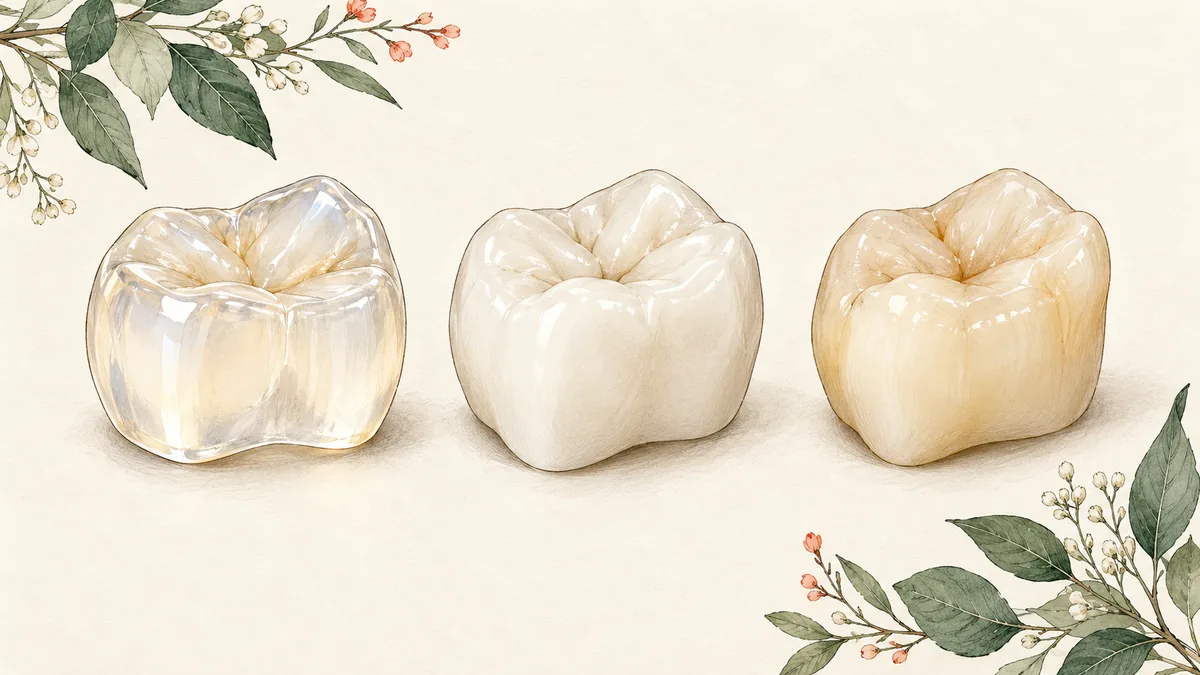
The material named on a dental quote is one of the details that tells you most, if you know what to ask. This page explains the three names that come up most often, e-max, zirconia and composite, and how to check your own plan; it belongs with our guide to cosmetic dental treatments.
The studies measure different things in different groups of people, from veneers to single crowns, over follow-up periods that range from one year to ten. We state what was measured each time, and we do not rank the materials, because the evidence does not support a ranking.
Why does the material matter?
A material changes four practical things: how well the restoration resists chipping and breaking, how much tooth has to be removed to make room for it, how it looks, and whether it can be repaired if something goes wrong. Survival studies capture the first.
An evidence-based review of anterior veneers addresses the second and fourth, and we use it below.5 We found no verifiable source on wear to the opposing teeth, so we make no claim about it. None of the survival studies we used measures appearance, so we make no claim about which material looks more natural. If appearance is your priority, ask a dentist to show you the shade and shape in your own mouth before treatment. For crowns specifically, our page on dental crowns explains when a crown is justified in the first place.
What is e-max (lithium disilicate)?
E-max is the name commonly used for lithium disilicate, a glass-ceramic. In the research it appears as a veneer material (our veneers guide covers what a veneer involves) and as a material for single crowns and bridges. The reviews below report on each use separately.
A 2025 meta-analysis of 29 studies put lithium disilicate veneer survival at 96.81% after 10.4 years, against 96.13% for feldspathic and 93.70% for leucite-reinforced glass-ceramic, with no difference between materials.1 The gap was in complications: the same review estimated that at 10.4 years technical, aesthetic and biological complications affected 6.1%, 1.9% and 0.45% of lithium disilicate veneers, against 41.48%, 19.64% and 6.51% for feldspathic porcelain.1
For crowns, a systematic review of 25 studies of lithium disilicate complete-coverage restorations found five-year survival of 95% to 100% and ten-year survival of 71.4% to 100%.6 The wide range is the finding: results varied a great deal between studies, and three-unit bridges did worse than single crowns. The authors say that, for lack of comparative studies, the long-term function of lithium disilicate compared with other materials is debatable.6
What is zirconia? Monolithic versus layered
Zirconia is a ceramic used for crowns and bridges. Two designs matter when you read a quote. In a layered design, a zirconia core is covered with a veneering ceramic fused on top. In a monolithic design, the whole crown is made from solid zirconia, with no separate layer.
The distinction matters because, as the review below reports, fracture of the veneering ceramic was a typical failure of zirconia crowns. In the 2015 systematic review of single crowns, pooled across 67 studies, zirconia crowns had five-year survival of about 91–92%, against 96.6% for reinforced (leucite or lithium-disilicate) glass-ceramic crowns and about 95% for metal-ceramic crowns. The review found zirconia crowns were more often lost through fracture of the veneering ceramic and loss of retention, and its authors said at the time that they should not be considered a primary option.2 Designs have changed since 2015, but the lesson holds: a newer material is not automatically a better one.
A 2014 review of zirconia-based crowns covered 16 studies, only three of them randomised trials, and reported five-year survival of 95.9% for crowns on natural teeth and 97.1% on implants. The review concluded that results were comparable to porcelain fused to metal, but based on a relatively small number of studies.3
For monolithic crowns specifically, a 2022 meta-analysis of nine studies covered 1,657 restorations followed for an average of about 1.07 years, with survival of 91% to 100% and high variation between studies.4 One study in it, of people with bruxism, reported only 31.60% survival of the marginal integrity.4 A follow-up of about a year cannot tell you how a crown behaves over a decade. For veneers, the 2025 veneer review found zirconia veneers surviving at 100% after 2.6 years, but noted there were no long-term data.1
What is composite?
Composite is a tooth-coloured resin that can be built up on the tooth directly, which is how bonding is done. The Journal of Adhesive Dentistry review states that direct composite veneers are usually more affordable than indirect ones, less invasive of the tooth structure and easier to repair.5
The same review adds that composite is susceptible to changes in surface gloss and discolouration, whereas indirect ceramic veneers need more invasive preparation and are harder to repair.5
This is a trade-off between durability and reversibility, not a ranking. Composite asks less of the tooth and can be mended, but it needs upkeep. Our page on composite bonding covers it in full.
How do the materials compare?
This is not a league table: the figures come from different kinds of restoration and different follow-up periods, and appearance is not measured by any of them. The table lists each material's main uses, reported survival, typical problems, repair and reversibility.
| Material | Used for | Survival reported | Typical problems reported | Tooth removal and repair | Reversible? |
|---|---|---|---|---|---|
| Lithium disilicate (e-max) | Veneers, single crowns | 96.81% of veneers at 10.4 years (2025 review1) | Fewer technical complications than feldspathic veneers at 10.4 years | No direct comparison of repair in our sources | No — tooth preparation is permanent |
| Zirconia (layered and monolithic) | Crowns, bridges; veneers with little data | About 91–92% (2015 review2) to 95.9% (2014 review3) of tooth-supported crowns at 5 years | Fracture of the veneering ceramic, loss of retention | Tooth removal and repair not compared in our sources | No — as above |
| Composite resin | Direct veneers, bonding | No single reliable figure; reported ranges are wide | Changes in surface gloss, discolouration | Less invasive and easier to repair than indirect ceramic (2021 review5) | Largely — little or no tooth removed, though the enamel is etched |
| Metal-ceramic (for reference) | Single crowns | About 95% at 5 years (2015 review2) | Not covered in this summary | Not covered either | No — as above |
How do you check what you are actually getting?
These questions turn a vague quote into a checkable one. Ask for the material by name for each tooth, who makes it and where, whether zirconia is monolithic or layered, why it was chosen, and what happens if it chips or fails.
- What is the material, by name, for each tooth? “Porcelain” and “ceramic” are loose words that cover several products, including feldspathic porcelain, which behaved differently in the veneer review.1 Feldspathic and silica-based ceramic crowns also did worse in the 2015 crown review.2
- If zirconia, is it monolithic or layered? The answer changes the main failure risk: the 2015 crown review found veneering-ceramic fracture a typical failure of zirconia crowns,2 while monolithic crowns have only about a year of follow-up.4
- Who makes it, and where? Ask for the name of the laboratory and whether the restoration is made on site.
- Why this material for this tooth? The reason should be about the tooth and the bite, not the package.
- What happens if it chips or fails? Ask for the replacement terms in writing, and whether the same material would be used again.
Keep the written plan and any material details you are given. They help a dentist at home later. For how long the work should last, see our guide to how long “Turkey teeth” last.
Frequently asked questions
-
Is e-max the same as porcelain?
Not exactly. E-max is a lithium disilicate glass-ceramic, whereas “porcelain” is used loosely for several ceramics, including feldspathic porcelain. In one veneer review, feldspathic and lithium disilicate had similar survival but different complication rates. Ask the exact material for each tooth, not just the word on the quote.
-
Which lasts longer, zirconia or e-max?
We found no study comparing them directly over the long term. The reviews we used report e-max veneers surviving at 96.81% after 10.4 years and zirconia crowns at about 91–92% to 95.9% after five years in two reviews, with different failure patterns. Those are different restorations and follow-up periods, so do not read them as a contest.
-
What is monolithic zirconia?
It is a crown made entirely from solid zirconia rather than a zirconia core with ceramic fused on top. That removes the layer that often fractures in layered designs, but the studies on monolithic crowns followed people for only about a year on average, so the long-term picture is not yet clear.
-
Is composite less durable than ceramic?
Composite is easier to repair and less invasive, but it is more prone to changes in surface gloss and discolouration. Survival figures for composite vary widely and mix several kinds of restoration, so we give no single number. The right choice depends on the tooth and on how you will look after it. See our composite bonding page.
-
Does the material affect how much tooth is removed?
It can. Preparation for indirect ceramic restorations is generally more invasive than for direct composite, and some designs need more tooth structure removed than others. The amount is decided by the tooth and the design as much as the material, so ask your dentist what will be taken from each tooth.
-
How can I find out what material I was given?
Ask the treating clinic for the written treatment record and the laboratory details. A dentist at home may be able to say what a restoration appears to be, but cannot always be certain, so the paperwork matters. Our guide to how long Turkey teeth last explains why.