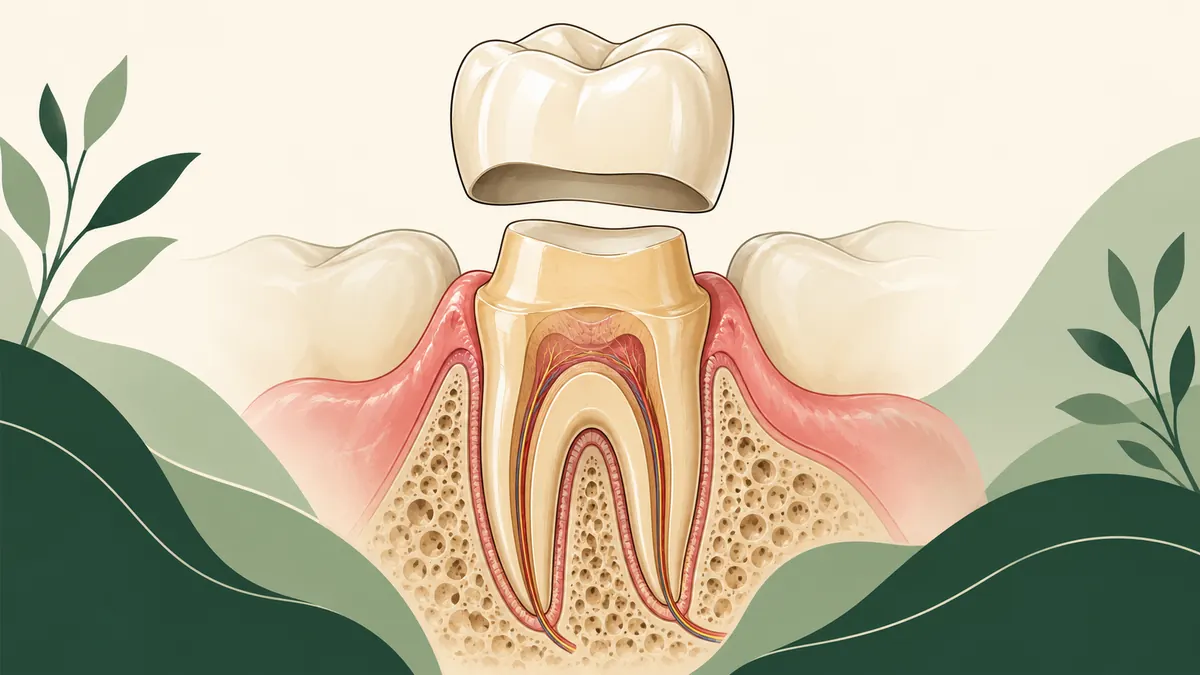
Here we explain when a crown protects a damaged tooth and when another option deserves consideration. Compare the options in our guides to cosmetic dental treatments and crowns versus veneers.
What does a dental crown do?
A crown surrounds the whole visible part of a tooth. One NHS hospital patient leaflet describes it as fitting over a tooth that has been re-shaped by the dentist, and says plainly that a crown does involve removal of some tooth structure.1
Once in place, a crown holds what is left of the tooth together, protects it from further wear or breakage, and restores its shape and, if that matters, its appearance. The tooth is not replaced. A crown is a cover over a prepared tooth, so the tooth underneath still needs cleaning, checking and protecting for as long as the crown is there.
When is a crown the right treatment?
The clearest cases are those in which the tooth itself is the problem. The same leaflet gives a large filling or decay, tooth wear and a tooth that has had root canal treatment as reasons a crown may be advised.1
The NHS guidance on dental treatments adds that crowns can be fitted where a tooth has broken, decayed or been damaged, or just to make a tooth look better.6
- A broken or cracked tooth, where the crown holds the pieces together.
- A large filling or extensive decay, where too little sound tooth remains to support another filling.
- A root-filled tooth, which has had its nerve treated and needs protecting.
- A badly worn tooth, where height or shape has been lost.
In these cases the crown is making up for strength the tooth has already lost, rather than altering a sound tooth. That is why the cost in tooth structure is easiest to defend here.
When is a crown not the right choice?
A crown is a much harder decision on a tooth that is sound and being treated for appearance alone. There is no existing problem for the crown to solve, so every consequence of the preparation is one that the treatment itself has created. Our page on tooth preparation sets out how much tooth is removed and what can follow.
One consequence is the nerve. A systematic review and meta-analysis of 37 studies found that the pulp died in about 5% of teeth after indirect restorations, which in the studies reviewed were mainly crowns and bridges, and rated the certainty of the evidence as low.5 One study in the review found a higher risk where a tooth already had decay, a filling or a crown, and the review found a higher risk for front teeth. A sound tooth may therefore start from a lower risk, but lower is not zero, and the figure itself comes from low-certainty evidence.
The hospital leaflet lists clenching or grinding, poor oral hygiene and active gum disease as situations in which a crown may not be suitable.1 The leaflet also says a tooth can sometimes be rebuilt with a white filling material that bonds to the enamel.1 Ask your dentist to say, tooth by tooth, which problem each crown is meant to solve. If the answer is “none, it is part of the package”, that deserves a second opinion.
Which materials are used for crowns?
An NHS hospital leaflet names porcelain fused to metal, metal alloy and all-ceramic or porcelain crowns, and says all-ceramic is used where the crown can be seen and the bite is not heavy.1 It also notes that some designs require more tooth structure to be removed than others.1
In England, the NHS charging page adds that you may be offered a metal-coloured crown on a back tooth.2
Newer names such as lithium disilicate (often sold as “e-max”) and zirconia are compared in detail on our page on crown and veneer materials. The practical point for now: a crown quote should name the material for each tooth. A word such as “porcelain” on its own covers very different products.
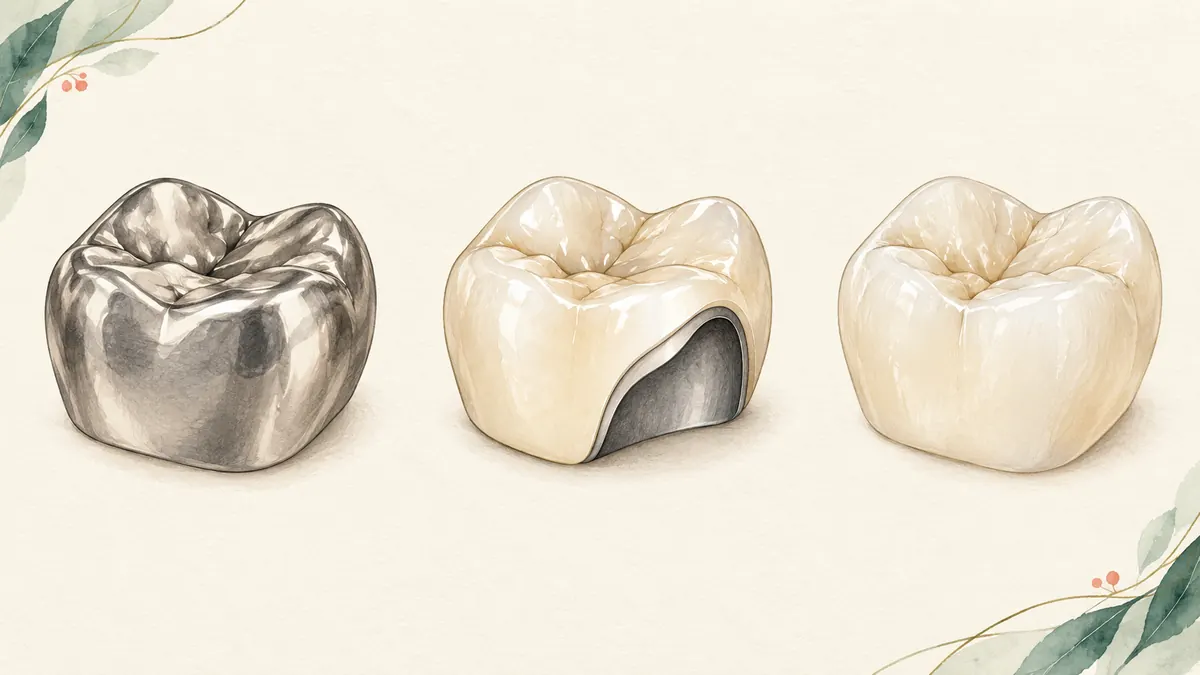
- All-metal
- Porcelain fused to metal
- All-ceramic
What does preparation for a crown involve?
Preparation means the dentist uses a drill to reduce the tooth to a smaller core, so that the crown has room to sit over it. The NHS puts it simply: to fit a crown, the old tooth needs to be shaped for the crown to be fixed on to.6
Because a crown surrounds the tooth all the way round, it takes more tooth than a restoration covering only the front; how much, and why it cannot be undone, is set out in tooth preparation.
While the permanent crown is made, the prepared tooth is usually protected with a temporary one. In the pooled analysis above, the risk to the nerve was higher where a temporary crown stayed in place for more than two weeks.5 That is worth knowing if the final crown is planned for a later visit, and it is a fair question to put to any dentist: how long will I wear the temporary one? If a crown comes loose in the meantime, our guide to NHS care and emergencies at home explains who to call.
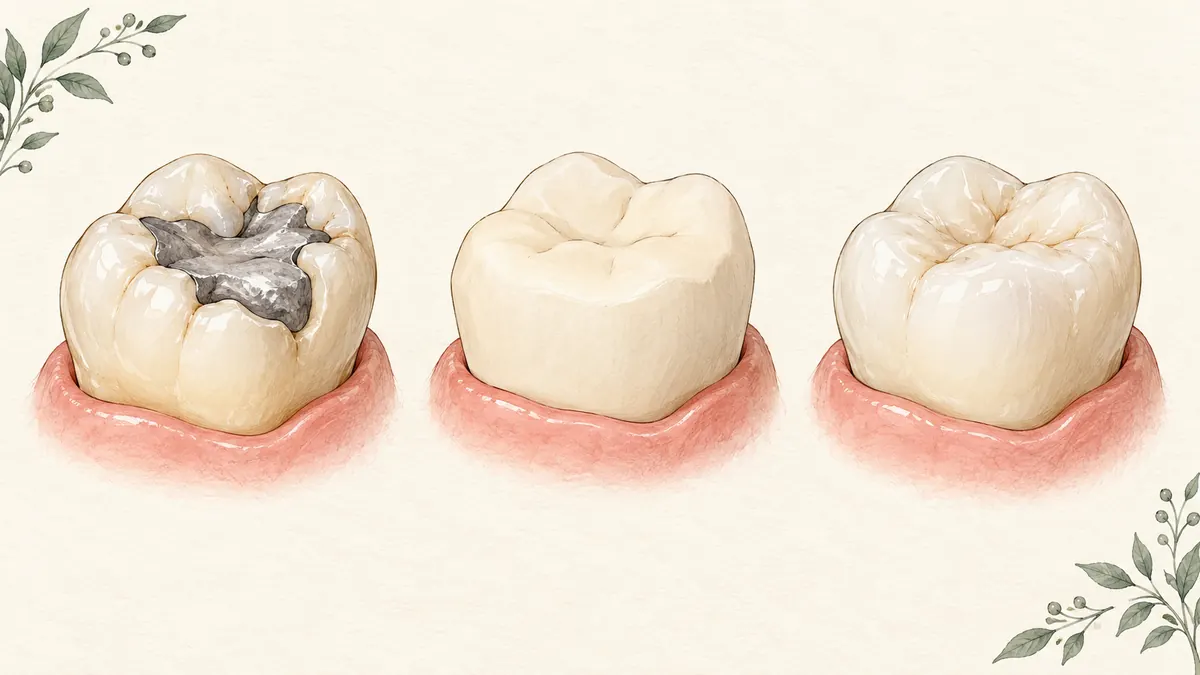
- Large filling
- Temporary crown
- Final crown
When to get help
- Your own dentist: a crown that has come loose, cracked or fallen off, or a tooth that stays sore to bite on.
- Your dentist or NHS 111, the same day: a swelling in the gum or face, a bad taste, or a fever.
- 999 or A&E: difficulty breathing, speaking, swallowing or opening your mouth; a lot of swelling in the mouth, face or neck; or a swollen or painful eye or sudden problems with your eyesight.
How long do crowns last, and what happens at replacement?
The Leeds leaflet says that a crown or veneer which is properly cared for should normally last around 8 to 10 years, depending on regular check-ups, brushing and flossing, and a diet low in sugar.1 That is a plain-English planning figure, not a guarantee, and it is consistent with the research below, which shows a wide spread around it.
In trials and clinical studies, results are better than that. Pooling 67 studies, a systematic review of single crowns reported five-year survival of about 95% for metal-ceramic crowns, 96.6% for reinforced glass-ceramic crowns and about 91–92% for zirconia crowns, with different kinds of failure in each.3 The materials page explains what lies behind those differences.
Real-world records are less flattering. An analysis of 47,474 crowns placed within the NHS in England and Wales found that 68% of metal crowns and 48% of all-porcelain crowns had not needed further treatment on the tooth ten years later.4 The outcome was any further treatment on the tooth, not just failure, and the crowns were placed between 1990 and 2002 with older ceramic technology, so these are not modern failure rates. They do show why replacement should be part of the plan from the start.
Replacement matters because the tooth beneath is usually prepared again. The NHS notes that crowns may need to be replaced in the future.2
What does a crown cost?
This page does not quote private prices for Turkey or the UK. What it can source is how NHS charging works. In England, crowns fall into Band 3, the highest of the three standard charge bands.2
Whether the NHS provides a particular crown depends on clinical need, which your dentist assesses. Wales, Scotland and Northern Ireland each charge differently, and the figures change from year to year.
Our cost guide gives the current NHS charges for each nation and advertised private crown prices in Turkey and the UK from our own survey, each with the date it was checked, and explains how to compare quotes like for like. Whatever the price, a quote for crowns should state which teeth, which material for each, how many visits are needed, and what happens if one fails.
Frequently asked questions
-
Does a crown mean the whole tooth is removed?
No. A crown covers the part of the tooth that is left. The dentist shapes the tooth to make room, which removes some of its outer structure, and that structure does not grow back. How much is removed depends on the tooth and the design, as our page on tooth preparation explains.
-
How long does a dental crown last?
An NHS hospital leaflet says a well-cared-for crown should normally last around 8 to 10 years. Studies report both shorter and longer results, depending on the material, the tooth and the person. Regular check-ups and good cleaning matter as much as the crown itself, so ask what the plan is for replacement.
-
Can I have a crown on a healthy tooth?
It is possible, but it is a significant step because the tooth must be reshaped first and that cannot be undone. Ask what problem the crown is meant to solve and whether a less invasive option would do. Our guide to crowns versus veneers sets out the difference.
-
Does the material of a crown matter?
Yes, because materials fail in different ways and some designs need more tooth removed than others. A quote should name the material for each tooth, not just say “porcelain”, because the word covers very different products. The materials page compares e-max, zirconia and composite, and what the evidence says about each.
-
Are crowns available on the NHS?
In England the NHS charges crowns at Band 3, and you may be offered a metal-coloured crown for a back tooth. Whether the NHS provides the crown you want depends on clinical need, which a dentist assesses. Charges differ across the UK, so check the cost guide for your nation.
-
What should I do if a crown comes loose?
Keep the crown if you can and contact your own dentist as soon as possible. If you have swelling, a bad taste or a fever, call your dentist or NHS 111 the same day. Call 999 or go to A&E if it is hard to breathe, speak, swallow or open your mouth, if your mouth, face or neck is very swollen, or if an eye is swollen or painful or your sight suddenly changes.