When to get help
- 999 or A&E: difficulty breathing, speaking, swallowing or opening your mouth; a lot of swelling in the mouth, face or neck; or a swollen or painful eye or sudden problems with your eyesight.
- Your dentist or NHS 111, the same day: swelling of the face or jaw, a high temperature, a bad taste, or severe toothache.
- Your own dentist: any persistent pain or tenderness in a crowned or filled tooth, or around an implant.
A GP cannot treat a dental problem, so a dentist is the right first call. The full routes are explained in NHS care and emergencies at home.
Most teeth that have had a crown, veneer or implant stay healthy, and this page is not a prediction that yours will not. It explains how infection and nerve problems arise, what the warning signs are and how they are treated, so that you can recognise one early. It is general information, not a diagnosis, and our overview of other risks of dental treatment covers the wider picture.
How can an abscess develop under a crown or other restoration?
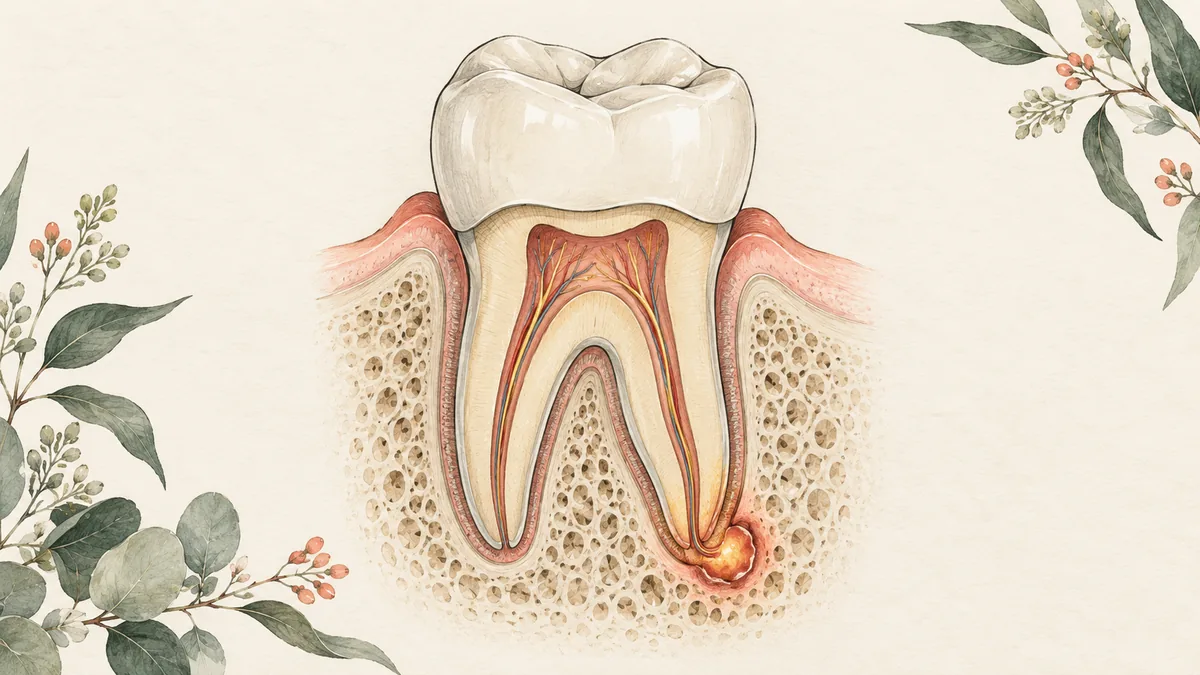
A crown or veneer covers the visible tooth but does not protect it from decay at its edges or from infection of the nerve inside. NICE guidance for clinicians2 explains that an abscess at the root tip begins in the dental pulp, the living centre of the tooth, and is usually secondary to decay.
The NHS root canal page4 lists decay, gum disease, and a chipped, broken or cracked tooth among the ways the pulp can become infected.
Preparing a tooth can irritate the pulp too. A systematic review and meta-analysis of 37 studies3 found pulp death in about 5.02% of teeth, and disease around the root tip in about 3.63%, after indirect restorations, which in the studies reviewed were mainly crowns and bridges. The risk was higher in front teeth and where a temporary stayed in for more than two weeks, and one study in the review found it higher where the tooth already had decay or an existing filling or restoration. The authors rated the certainty as low and concluded that incidence remains low overall. How the tooth is shaped is covered in tooth preparation.
| Problem | What is affected | What the sources say | Typical treatment |
|---|---|---|---|
| Dying tooth nerve (pulp necrosis) | The pulp inside the tooth | About 5% after indirect restorations in one pooled analysis; low certainty | Root canal treatment or removal of the tooth |
| Abscess or other disease at the root tip | Bone and tissue around the root | About 3.6% in the same analysis; it needs a dentist | Drainage, root canal treatment or removal; sometimes antibiotics |
| Jaw nerve numbness after implants | A nerve in the lower jaw | Described as very rare, and usually settling over time | Review by the implant dentist; planning with 3D imaging helps prevent it |
What are the signs of an abscess?
The NHS lists1 intense toothache, redness, sensitivity to hot or cold, a bad taste in the mouth, difficulty opening your mouth, a swollen face or jaw, swollen glands in your neck and a high temperature. Not everyone has all of them, and a tooth can be infected with little pain, so a change that persists is worth reporting.
Treatment is by a dentist. The NHS describes draining the abscess, possibly root canal treatment or taking the tooth out, and sometimes antibiotics. The NICE summary2 says antibiotics are generally not indicated in otherwise healthy people without signs of spreading infection, which is one reason painkillers and a prescription are not a substitute for dental treatment.
Which symptoms need same-day care?
Swelling is the symptom to watch. A swollen face or jaw, with or without a fever, should be seen by a dentist the same day, or assessed through NHS 111 if you cannot reach one. Do not wait for a reply from a clinic abroad if you have any of these signs.
The NHS says1 to call 999 or go to A&E if it is hard to breathe, speak, swallow or open your mouth, if there is a lot of swelling in your mouth, face or neck, or if you have a swollen or painful eye or sudden problems with your eyesight. The clinical guidance goes further and names swelling in the floor of the mouth, spreading facial infection and neurological signs among the reasons to admit someone to hospital.
Treat the situation as you would if the work had been done down the road.
When does root canal treatment become necessary?
It is needed for infection inside the tooth. The NHS explains4 that root canal treatment removes an infection from inside the tooth, that it usually takes two or more appointments, and that without it you may need the tooth taken out. A crown may be needed afterwards if the tooth was badly infected.
If a tooth that was prepared for a crown develops this problem, the sequence can mean further work on a tooth that has already been reduced; see pain and sensitivity after crowns or veneers for the earlier symptoms.
Can implant surgery cause numbness?
Rarely. The Cambridge hospital leaflet5 describes numbness after implant surgery as very rare and usually resolving over time, though very rarely permanent. In the lower jaw the risk depends on how close the implant sits to the nerve canal, and the review below calls for careful planning with 3D imaging.
A systematic review and meta-analysis6 of damage to the nerve that runs through the lower jaw found changes in sensation in 0% of patients whose implants were 1 mm or more from the nerve canal, but 68% where the implant was within 1 mm and 53% where it entered the canal. The review covers the lower jaw only, and it cannot tell you the risk for a particular implant. See implant failure for other problems after implant surgery.
How can you reduce the chance of infection?
The factors in the evidence are largely ordinary ones. Decay and gum disease are routes into the pulp, as the NHS root canal page4 explains, so treating them before a crown or veneer is fitted matters. Clean carefully around restorations and implants, attend check-ups, and report symptoms early.
One study in the pooled analysis3 found a higher risk where a tooth already had decay or an existing filling or restoration, and a plan made without X-rays cannot account for those.
For what to put in place before treatment abroad, see NHS care and emergencies at home; for how treatment can go wrong more broadly, when “Turkey teeth” go wrong.
Frequently asked questions
-
Can an abscess form under a crown?
Yes. A crown covers the tooth but does not protect it from decay at its edge or from infection of the nerve inside, and either can lead to an abscess. The NHS says an abscess needs urgent treatment by a dentist and will not go away on its own. Our guide to NHS care and emergencies explains who to call.
-
What are the signs of a dental abscess?
The NHS lists intense toothache, redness, sensitivity to hot or cold, a bad taste, difficulty opening your mouth, a swollen face or jaw, swollen neck glands and a high temperature. Not everyone has all of them. See your dentist the same day if you have swelling or a fever; our page on pain and sensitivity covers milder symptoms.
-
When is a swollen face an emergency?
Call 999 or go to A&E if it is hard to breathe, speak, swallow or open your mouth, if your mouth, face or neck is very swollen, or if an eye is swollen or painful or your sight suddenly changes. For milder facial swelling, see a dentist the same day, or NHS 111 if you cannot reach one.
-
Will I need root canal treatment?
If the nerve is infected, the NHS says root canal treatment removes the infection from inside the tooth, and that without it you may need the tooth taken out. In one pooled analysis the nerve died in about 5% of teeth after indirect restorations, which in the studies reviewed were mainly crowns and bridges. See tooth preparation for more.
-
Can dental implants damage a nerve?
Rarely. A hospital leaflet describes numbness after implant surgery as very rare and usually settling over time. Research on the lower jaw found nerve changes were concentrated where an implant sat very close to the nerve canal, which is why 3D imaging matters. Our page on implant failure covers other implant problems.
-
Can a GP treat a dental abscess?
No. The NHS says GPs cannot give dental treatment, so a dentist is the right route, and NHS 111 can help you find urgent dental care if you cannot reach one. Our page on finding a dentist covers what to do when a practice will not take you on.