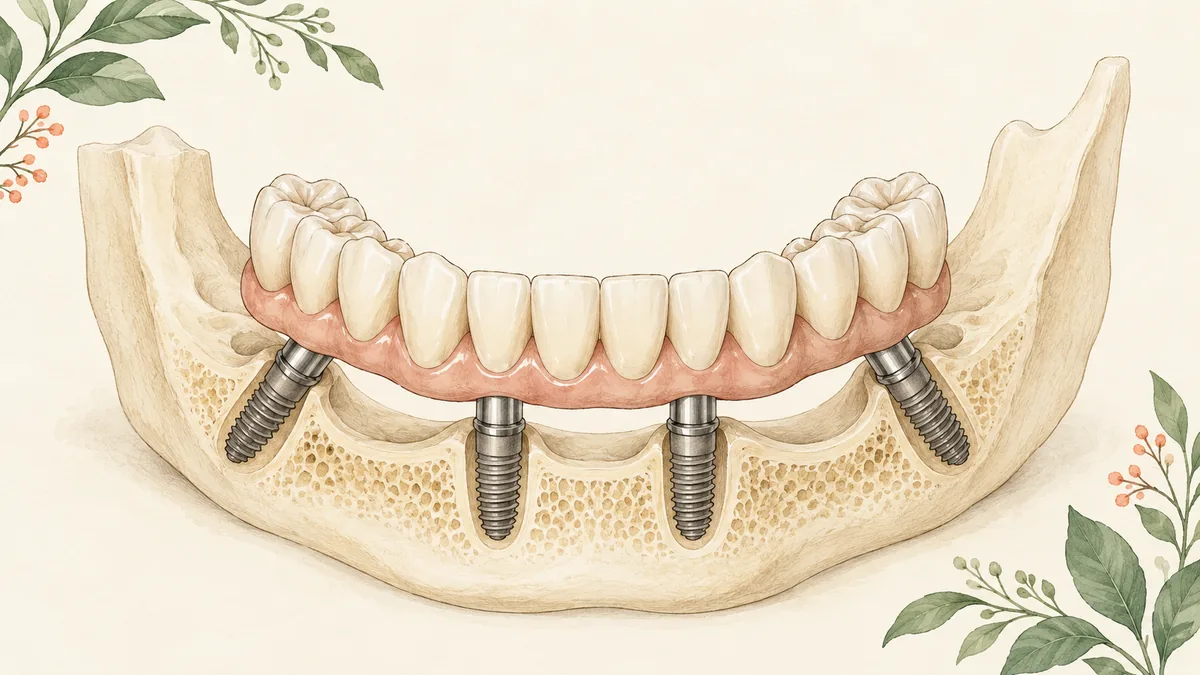
All-on-4 appears constantly in cross-border dental marketing, so it helps to know what it is and what the published evidence does and does not say. For implants in general, including the standard timeline, read our guide to dental implants, and for the other options see the wider guide to cosmetic dental treatments.
What is All-on-4?
All-on-4 is a full-arch treatment concept: a one-piece fixed bridge of replacement teeth is attached to four implants in one jaw. An overview of 36 systematic reviews of the edentulous upper jaw describes it as a one-piece fixed prosthesis on at least two upright front and two tilted back implants, instead of six to eight upright implants.3
“Fixed” means you cannot take it out yourself, unlike a denture. That tilted arrangement is what “All-on-4” refers to.
Anatomy of the treatment
One fixed bridge, four implants

What does the evidence say?
A systematic review of the all-on-four concept covered 24 studies and reported implant survival of 99.8% beyond 24 months, with biological complications such as peri-implantitis in few patients after a mean follow-up of two years.1 Its authors stress that the evidence is limited, because of poor methodological quality, patients lost to follow-up and short observation times.1 The overview also reported overall survival above 95% for fixed full-arch treatment on four or more implants, and said no rehabilitation of the edentulous upper jaw should rest on fewer than four.3
Two things are missing. We found no independent All-on-4-specific figure that follows patients for 10 years, so we cannot give one. We also found no reliable published outcome data for All-on-4 carried out in Turkey, so we make no claim for or against it there. The first two years are not the whole story of a fixed bridge worn for decades.
Who is All-on-4 for?
A 2017 consensus statement gives the main indication as an atrophic upper or lower jaw, one where the bone has shrunk, in patients rated ASA I or II, meaning people who are otherwise healthy or have mild systemic disease.2
In practice that means people who have lost most or all of their teeth, or whose remaining teeth cannot be saved. Treat that statement with care. It came from a conference bearing an implant manufacturer’s name, it is an expert consensus rather than an independent review, and its own authors note the weakness of the available evidence. It is useful as a description of what the technique is designed for, not as proof of how well it works.
What is All-on-4 not?
It is not a cosmetic shortcut for people whose teeth are healthy and who would like a new smile. Removing sound teeth to place implants is a major, permanent step: extraction cannot be undone, and the bone and gum around implants need lifelong care.
None of the sources we used presents removing healthy teeth as a reason for the treatment. The main indication the consensus statement gives is a jaw where the bone has shrunk.2 If a plan to extract teeth that look healthy is put to you, ask for the clinical reason for each tooth in writing, and get a second opinion from a dentist in the UK before you travel. Ask too what would happen if the teeth were kept and treated one by one.
What is the All-on-4 timeline?
Two broad protocols exist. In conventional loading, the implants heal for months before the bridge is attached. In immediate loading, a provisional bridge is attached soon after surgery. In a systematic review and meta-analysis of 62 studies, one-year implant survival was estimated above 99% for every protocol, although the authors say caution is needed in interpreting the results.5
The same review covered 13,653 implants in 2,757 toothless jaws. It reported implant survival of 90.1% to 100% with immediate loading (followed for 1 to 10 years) and 94.95% to 100% with conventional loading (2 to 15 years).5
According to the consensus statement, immediate loading needs an insertion torque above 35 Ncm, a measure of how firmly the implant sits in the bone at surgery. The statement also reports that the main prosthetic complications are fractures of the provisional acrylic bridge.2
For comparison, a Cambridge NHS hospital leaflet says an implant usually heals in the bone for three to six months but can take longer, and that total treatment usually takes at least one year; it adds that a bone graft prolongs treatment by at least four months.6 Those figures describe conventional implant treatment, not All-on-4. They show why a short timetable is a clinical decision, and why you should ask which protocol is planned, what criteria were used to choose it and what the temporary bridge is made of.
What bone and gum requirements apply?
A Cambridge NHS hospital leaflet reports that implants have a success rate of 80% to 95% over 15 years in patients with healthy mouths, and 80% to 85% over seven years in patients with gum disease.6 These are figures for implants in general, not for All-on-4.
The leaflet also says smokers have a much greater failure rate and are expected to stop at least six months before treatment, and that grinding the teeth carries a risk of overloading the implants.6
Where bone is limited, tilting the back implants is one response. A systematic review of tilted implants in the immediate loading of the upper jaw analysed 11 articles, with 1,623 implants in 324 patients, and found first-year failures in 2.19% of tilted implants against 1.89% of upright ones, a difference that was not statistically significant. Its authors state that long-term randomised trials are needed.4
In practice, ask what imaging has been done, what the bone and gum assessment found, and whether grafting or a staged approach was considered. A plan made without a scan of the jaw cannot say where, or whether, implants will fit.
What maintenance and hygiene does a full-arch bridge need?
An NHS leaflet warns that inflammation of the gum around an implant (mucositis) or bone loss around it (peri-implantitis) can develop if implants are not cleaned properly, and advises reviews every three to six months.6 A fixed bridge cannot be taken out at home, so ask who will check it and how often.
The consensus statement describes the pattern of problems: the most frequent biological complication was the loss of at least one implant, followed by peri-implantitis and inflammation of the gum around the implant.2
Ask to be shown how you will clean around and under the bridge and which tools you will need. If you will be flying home soon after surgery, work out in advance who will do that checking, because it is a commitment that lasts for the life of the bridge. Our page on implant failure explains the warning signs.
What does All-on-4 cost?
This page quotes no prices. Our cost section shows advertised starting prices for All-on-4 per jaw, from our own survey of clinic and practice websites accessed October 2026, with what they include and leave out. Our guide to what dental treatment costs in Turkey also explains how packages are put together and how to compare them.
Our page on UK private costs gives the other side. For a full-arch quote, the useful items are the number of implants and the implant system used, whether the bridge supplied on the day is provisional or final, what the final bridge is made of, how many visits are included, what happens if an implant fails, and who provides follow-up. A quote that leaves these out cannot be compared with another.
Frequently asked questions
-
Is All-on-4 permanent?
The bridge is fixed, meaning you cannot remove it yourself, but that is not the same as permanent. Implants and bridges need regular reviews and cleaning, and parts can fracture or fail. Extracting teeth to make room for it cannot be undone. The studies we found followed patients for a limited time.
-
How long does All-on-4 last?
We found no independent All-on-4-specific figure that follows patients for 10 years. A review reported 99.8% implant survival beyond 24 months but called the evidence limited. For implants generally, an NHS hospital leaflet gives 80% to 95% over 15 years in healthy mouths. Ask your dentist what applies to you.
-
Can I have All-on-4 if I smoke?
Smoking is linked to a much greater failure rate, according to an NHS hospital leaflet, which expects patients to stop at least six months before implant treatment. Smoking is a reason to discuss the plan carefully with a dentist, and ideally with one who will still be seeing you in years to come.
-
Is All-on-4 suitable if my teeth are healthy?
It is designed for jaws that have lost most of their teeth or have teeth that cannot be saved. If you are offered it while your own teeth are sound, ask for the clinical reason for each extraction in writing and get a second opinion. Our guide to dental implants covers other options.
-
Do you get teeth on the same day?
Sometimes a provisional bridge is attached soon after surgery, which is called immediate loading. A consensus statement says this needs the implants to sit firmly in the bone at surgery. The provisional bridge is not the final one, so ask what it is made of, how long you will wear it and what changes later.
-
What if something goes wrong when I am back in the UK?
Contact your own dentist first. For swelling, fever or severe pain, call your dentist or NHS 111 the same day, and call 999 or go to A&E if it is hard to breathe, speak, swallow or open your mouth, or if there is a lot of swelling in your mouth, face or neck. Our page on implant failure explains the warning signs and why aftercare should be agreed before treatment.