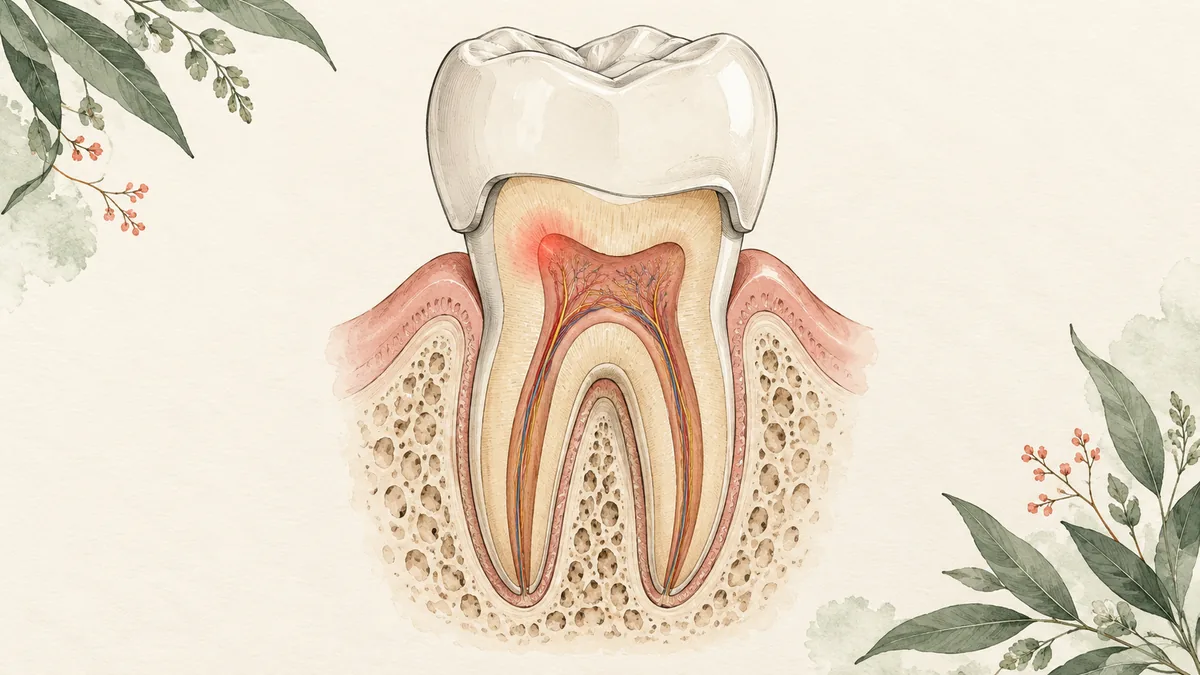
A tooth that has been reshaped for a crown or veneer can feel different for a while. This page separates what is a normal part of settling from what is a reason to go back to a dentist. It does not replace an examination, because sensitivity and pain have several causes that look alike. For why a tooth is prepared at all, see tooth preparation, and for the bigger picture, our overview of other risks of dental treatment.
What is normal in the first days after treatment?
Dentine, the layer beneath enamel, is made of tiny channels that lead towards the nerve. When enamel is thin or has been removed, these channels can be exposed, and the tooth may react to hot, cold or sweet food, or to air. The NHS toothache page1 notes that tooth pain can also be caused by having sensitive teeth.
A review written for dental practitioners3 describes the hydrodynamic theory, in which fluid moving inside exposed channels triggers the pain, as the widely accepted explanation. A short, sharp reaction to temperature is therefore a recognised symptom in its own right. What we could not find is a published figure for how often it follows crown or veneer preparation, or how long it usually lasts, so we cannot give you a number of days. Ask your dentist what to expect for your treatment, and when you should call.
What is not normal?
The NHS1 says to see a dentist if toothache lasts more than two days, does not go away with painkillers, or comes with a high temperature, pain when you bite, red gums or a bad taste, or if your cheek or jaw is swollen.
We would add that pain which is increasing, rather than easing, is worth mentioning at the same time.
When to get help
- Your own dentist: pain that is not easing, a tooth that hurts to bite on, or a bad taste.
- Your dentist, promptly: swelling of the cheek or jaw, red gums or a high temperature. If you think you have an abscess, ask for an urgent appointment or contact NHS 111.
- 999 or A&E: difficulty breathing, speaking, swallowing or opening your mouth; a lot of swelling in the mouth, face or neck; or a swollen or painful eye or sudden problems with your eyesight.
Who to call, and what the NHS does and does not cover, is explained in NHS care and emergencies at home.
| What you notice | What it might mean | What to do |
|---|---|---|
| A brief, sharp twinge with hot, cold or sweet things that fades quickly | Sensitive dentine | Mention it to your dentist; ask how long to expect it |
| Pain lasting more than two days, or not easing with painkillers | Needs assessment; several causes are possible | Contact your own dentist |
| Pain when you bite | A damaged tooth, a gum problem, infection or a restoration that needs adjusting | Contact your own dentist |
| Bad taste, red gums, high temperature or a swollen cheek or jaw | Possible infection | Contact your dentist promptly; if you think you have an abscess, ask for an urgent appointment or contact NHS 111 |
| Difficulty breathing, speaking, swallowing or opening your mouth; a lot of swelling in the mouth, face or neck; a swollen or painful eye or sudden eyesight problems | Emergency | 999 or A&E |
Why does sensitivity happen after crowns and veneers?
Sensitivity after crowns and veneers usually comes from preparation exposing dentine, a temporary restoration, your bite or decay beneath the restoration. Because these causes overlap with one another and with other dental conditions, only a dentist can say which applies to you, and the pooled figures below show how common sensitivity is even without treatment.
Sensitive teeth are common even without any treatment. Across 77 prevalence studies in a range of populations, a meta-analysis2 put the best estimate of dentine hypersensitivity at 11.5%, with an average across all studies of 33.5% and individual studies ranging from 1.3% to 92.1%. The authors noted extreme differences between studies, and the figures are not specific to people with crowns or veneers.
The contributors in more detail:
- Preparation. Removing enamel can expose dentine, as described above.
- A temporary restoration. Between preparation and the final fit the tooth is covered only by a temporary. The pooled analysis described below found a higher risk of nerve death when a temporary stayed in place for more than two weeks.
- Your bite. A restoration that sits slightly high, or grinding and clenching, puts extra load on the tooth. The NHS grinding page5 says grinding can cause worn or broken teeth, which can increase sensitivity.
- Decay beneath the restoration. The NHS tooth decay page6 lists sharp pain with hot, cold or sweet things among the symptoms of decay, which can also reach the nerve and cause an abscess.
Because these overlap, the review for practitioners notes that several dental conditions mimic dentine sensitivity and that diagnosis is often confusing. Desensitising products work by blocking exposed channels, but the authors describe their long-term outcome as uncertain.
When does sensitivity signal that the nerve is involved?
The pulp is the living centre of the tooth, holding its nerve and blood supply, and a crown or veneer can irritate it. Pain alone cannot tell you whether the pulp is inflamed, recovering or dying, which is why a dentist will test the tooth and usually take an X-ray.
A systematic review and meta-analysis of 37 studies4 found that the pulp died in about 5.0% of teeth, and disease developed around the root tip in about 3.6%, after indirect restorations, which in the studies reviewed were mainly crowns and bridges. The risk was higher in front teeth and where a temporary restoration stayed in for more than two weeks, and one study in the review found it higher where the tooth already had decay or an existing filling or restoration. The authors rated the certainty of the evidence as low and concluded that incidence remains low overall.
If the nerve of a tooth has died, a dentist may recommend root canal treatment. The signs that an infection has developed are set out in infection and nerve damage.
What should you do, and who should you contact?
Start with your own dentist, or the dentist who has taken over your care. Note when the pain started, what sets it off, how long it lasts and whether it wakes you, as that helps with diagnosis. If you cannot reach a dentist and the problem is urgent, NHS 111 can advise.
What the NHS will and will not do after treatment abroad is set out in NHS care and emergencies at home. Our guide to finding a dentist after treatment abroad covers what to do when a practice declines to see you.
If you grind or clench your teeth, say so. The NHS teeth grinding page5 says a dentist may recommend a mouth guard or splint. Grinding also bears on how crowns and veneers are chosen; see crowns versus veneers.
Frequently asked questions
-
Is sensitivity after crowns or veneers normal?
Some sensitivity to hot, cold or sweet food can be part of a tooth settling after treatment, but we found no reliable figure for how often it happens or how long it lasts. If it is severe, lasts more than two days without easing or comes with pain on biting, contact your dentist. See tooth preparation for why teeth react.
-
How long does sensitivity last after a crown?
We found no reliable published figure, so we cannot give a number of days or weeks. Ask your dentist how long to expect it for your treatment and when to call. If a tooth is still painful after that, or getting worse, go back. Our guide to NHS care and emergencies explains who to contact.
-
Why does my tooth hurt when I bite after a crown?
The NHS lists pain when you bite among the reasons to see a dentist. It can have several causes, including a damaged tooth, a gum problem, infection or a restoration that needs adjusting, and the symptom alone cannot tell which. Your dentist can examine and X-ray the tooth. Our page on infection and nerve damage explains the warning signs.
-
Could the nerve of my tooth have died?
It can, in a minority of prepared teeth. A pooled analysis of 37 studies found the nerve died in about 5% of teeth after indirect restorations, which in the studies reviewed were mainly crowns and bridges, although the certainty was low. Persistent pain, a bad taste or swelling are reasons to be seen; read infection and nerve damage.
-
Who do I contact about pain after treatment abroad?
Call your dentist, or NHS 111 if you cannot reach one. Call 999 or go to A&E if breathing, speaking, swallowing or opening your mouth is difficult, if your mouth, face or neck is very swollen, or if an eye is swollen or painful or your sight suddenly changes. Turned away by a practice? See finding a dentist.
-
Can grinding cause sensitivity with crowns or veneers?
The NHS says grinding can wear or break teeth, which can increase sensitivity, and a dentist may recommend a mouth guard. Tell your dentist if you clench or grind, because it also affects which restoration suits you. Our comparison of crowns and veneers sets out how the options differ.