The phrase “Turkey teeth” is widely used, but what it covers is not always clear. This guide explains what it usually refers to, what the treatment involves, and what is worth weighing before you decide, wherever you are treated.
We are an independent guide. We are not a dental clinic, we provide no treatment, and we do not rank or recommend clinics or dentists. Nothing here tells you to go or not to go. It tells you what to ask.
Where did the phrase “Turkey teeth” come from?
It is a popular label, not a clinical term. We found no definition from the NHS, the National Institute for Health and Care Excellence (NICE) or the British Dental Association (BDA), and no reliable date for first use. In everyday use it describes cosmetic dental work, typically crowns or veneers on several teeth, carried out in Turkey.
What can be said comes from research on how the subject spreads. A British Dental Journal analysis of 131 UK newspaper articles on dental tourism described its popularity with young people following a wave of viral social media content, and concluded that the press amplified those social media perspectives.1 That study examined how the subject was reported, not how patients fared.
Price is the other part of the story. In the BDA’s survey of more than 1,000 UK dentists, 98% of dentists cited cheaper costs as the main reason patients go abroad.3 Those are dentists’ views of why patients go, not patients’ own answers.
If you arrived here after seeing before-and-after photographs, our page on why we publish no gallery explains the reasoning and how to read such photos critically.
What does the treatment usually involve?
There is no single “Turkey teeth” procedure. The label covers cosmetic crowns and veneers, sometimes with implants, and the details differ from one treatment plan to the next. Two plans that sound similar can differ greatly in how much healthy tooth they remove.
Crowns, not veneers: why the words get mixed up
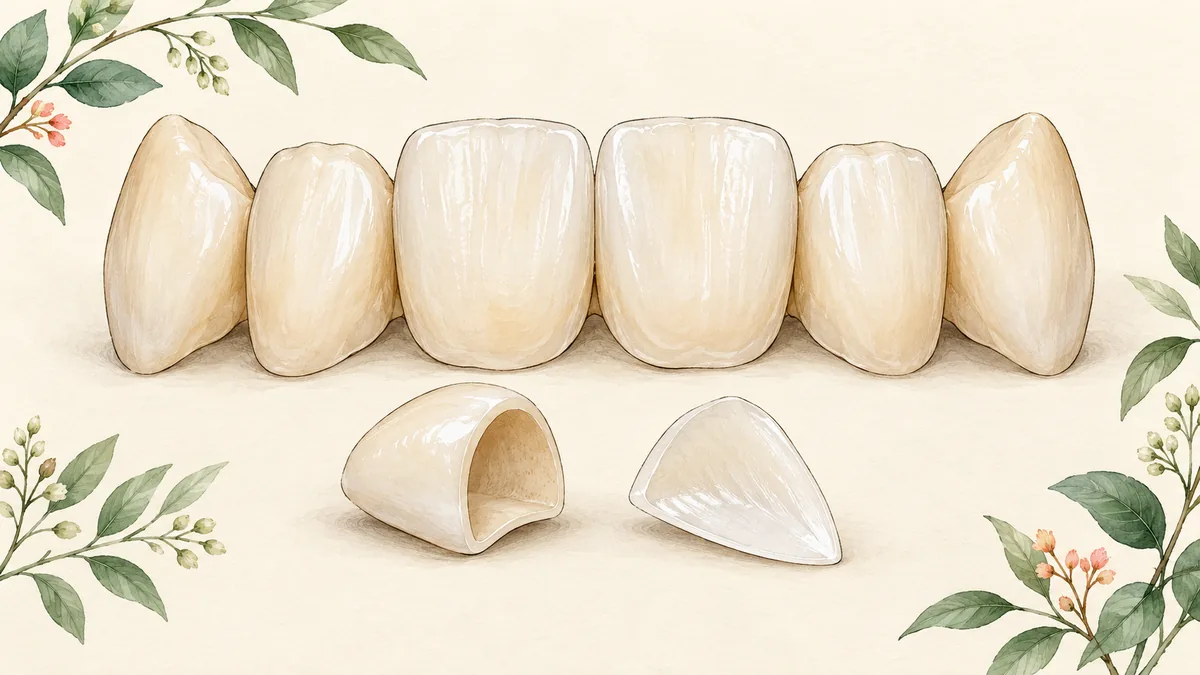
A veneer is a thin shell fixed to the front of a tooth. A crown fits over the whole visible tooth. The NHS describes the difference through preparation: a crown needs the old tooth shaped to carry it, while for a veneer the front is drilled away a little, although not all veneers need this.2
We found no reliable count of how many “Turkey teeth” treatments are crowns and how many are veneers, so we cannot tell you which is more common. Everyday speech uses “veneer” loosely, and a quote that says “veneers” may describe something else. Our guide to why a quote may describe crowns, not veneers shows how to tell the two apart.
| Feature | Veneer | Crown |
|---|---|---|
| What it covers | The visible front of the tooth | The whole visible tooth |
| Preparation, in NHS wording | Front drilled away a little; not all designs need this | Old tooth shaped to carry the crown |
| Reversible | No — tooth preparation is permanent | No — tooth preparation is permanent |
| What to ask | Is any enamel removed, and how much? | Does this tooth need a crown? |
For the trade-offs in more detail, see our full comparison of crowns vs veneers.
A veneer covers the front of a tooth. A crown covers the whole visible tooth. A crown needs the tooth shaped to carry it, and a veneer may need some enamel removed too; either way, tooth that is taken away does not grow back.
How much tooth is removed
Any crown or veneer that needs preparation takes away enamel, and sometimes the dentine beneath it, and that loss is permanent. A crown generally takes considerably more than a veneer, and the amount for your own teeth depends on the design, the tooth and the dentist. The measured figures from laboratory research, and why they cannot predict your result, are set out on our tooth preparation page. We do not repeat them here.
Materials commonly used
Quotes may name materials such as zirconia or lithium disilicate, the latter often sold as “E-max”, and some use porcelain fused to metal. We have no verified source on which materials are most used in Turkey, so we do not say. The practical point is that a quote should name the material and the laboratory. Without that, you cannot compare one quote with another, or explain the work to a UK dentist later.
What does the process look like?
The process runs in five broad stages in any country: assessment, tooth preparation, laboratory work, fitting and follow-up. Who carries them out and how long each takes varies, and we found no reliable source for the days or visits involved in Turkey, so ask for your schedule in writing.
- Assessment. The General Dental Council advises that you should always be assessed by a qualified dentist before being given a treatment plan and cost estimate.4 X-rays are the usual way to see decay, existing fillings and the condition of the nerve, so a plan made without them is missing information.
- Preparation. The tooth is shaped, an impression or scan is taken, and a temporary cover is usually fitted.
- Laboratory work. The crown or veneer is made to the dentist’s specification.
- Fitting. Fit, bite and appearance are checked before the final restoration is fixed in place.
- Follow-up. Check-ups confirm that the gums and bite have settled.
Remote consultations can help you compare options, but they cannot replace an examination. The NHS lists a hard sell, pressure to decide quickly, no discussion of complications and no mention of aftercare as reasons to think carefully before booking.6
Who can it suit?
Qualified dentists work in Turkey, as they do everywhere, and some people need exactly this work. The NHS notes that crowns can be fitted where a tooth is broken, decayed or damaged, or to make a tooth look better.2
A tooth that is broken, heavily filled, worn down or already root-treated is a different case from a sound one. There the choice is between a weakened tooth and a protected one, and a crown may be the sensible treatment in any country.
Who does it not suit?
The cases that deserve a harder look are those where the teeth are sound and the reason is appearance alone. Preparing a healthy tooth is a permanent decision, and a less invasive option may meet the same goal. Others to weigh are untreated gum disease or decay, expectations no one can promise, and plans covering many teeth at once.
- Sound teeth, appearance only. Ask what each tooth needs, not what the package includes.
- Untreated gum disease or decay. Ask whether your gums and any decay have been assessed and dealt with first, and ask for that in writing.
- Expectations that no one can promise. A result that matches a photograph you saw online is not something a dentist can promise for your teeth, face and bite.
- A plan for many teeth at once. There should be a clinical reason for each tooth, not only for the set. Our page on “smile makeover” and “Hollywood smile” packages explains why the number of teeth is a clinical decision.
What does it cost?
This site shows prices only on its cost pages, and this page quotes none. Those pages give advertised starting prices from our own survey of clinic and practice websites, accessed October 2026, with what the prices include and leave out: see what treatment costs in Turkey and private fees in the UK.
Our guide to what it costs explains how to compare quotes like for like. Two points belong here. First, the NHS says veneers are generally only available privately unless you can show a clinical need.2 Second, a low price is a clinical question as well as a financial one: ask what time, planning and laboratory work it includes, and what it leaves out. Putting work right later is a cost of its own, covered in the same guide.
What are the risks, in outline?
There are two main risks. The first is permanent: tooth structure removed during preparation does not return. The second is that problems may need treatment later, and UK dentists in a BDA survey reported complications most often with crowns, though that reflects dentists’ experience, not a rate.3 Our page on how much tooth is removed covers the first.
In the same BDA survey of more than 1,000 UK dentists, 95% had examined patients treated abroad and 86% of those had treated complications.3 Crowns were the treatment most likely to need follow-up work, closely followed by implants. These are dentists’ reports, not the share of all patients with problems, and the page shows no date. We found no peer-reviewed complication rates for treatment in Turkey, so we do not quote one.
Whether a given treatment is safe depends on the diagnosis, the plan, the dentist and the follow-up. Our page on whether Turkey teeth are safe sets out the conditions.
How long do they last?
We found no reliable figure for how long work done in Turkey lasts, and we found no source that supports a promise of “lifetime” results. Lifespan depends on the material, how well the restoration fits, the condition of the tooth beneath it and how you look after it.
Restorations do not last for ever, and replacing one is done on a tooth that has already been prepared.
What research can tell you about crowns and veneers in general, including its limits, is on our page about how long they last.
What happens when it goes wrong?
The problems are those any crown or veneer can have: sensitivity or pain, a bite that feels wrong, irritated gums, a restoration that loosens or chips, decay beneath it, or a result you are unhappy with. Some can be corrected. Tooth structure lost during preparation cannot be put back.
Our guide to when “Turkey teeth” go wrong covers why problems happen, what is fixable and what to do first, without sensational cases or photographs. For who to call and what the NHS does and does not cover, see NHS care and emergencies at home.
Before you book: what about aftercare?
Plan aftercare before you travel, not after. The Foreign Office says that planned medical treatment is a commercial arrangement and that it cannot usually help if you have travelled abroad for it.5 Its guidance adds that standard travel insurance does not normally cover you if you travel abroad for elective surgery, and may not cover costs from complications.5
The General Dental Council adds that you should speak to your own dentist before travelling, so that they know your plans if complications follow.4 Our guide to NHS care and emergencies at home explains what the NHS will and will not do once you are home.
Before you travel, it is worth arranging the following:
- Tell your own dentist, and book a check-up for when you return.
- Ask for a written plan that names each tooth, the treatment, the material and the laboratory.
- Ask for copies of your X-rays and treatment records.
- Get the guarantee terms in writing, including who pays for travel if you must go back.
- Check your travel insurance wording for planned treatment and its complications.
NHS dental charges and arrangements differ across the four UK nations (see NHS dental charges explained), so check the rules where you live. To check who will treat you, read about checking a dentist’s registration. Our guide to aftercare once you’re home sets out who takes responsibility for what.
When to get help
- Your own dentist: pain, a loose or broken crown, or a bite that feels wrong.
- Your dentist or NHS 111, the same day: swelling in the gum or face, a bad taste, or a fever.
- 999 or A&E: difficulty breathing, speaking, swallowing or opening your mouth; a lot of swelling in the mouth, face or neck; or a swollen or painful eye or sudden problems with your eyesight.
Which less invasive options should you consider first?
A sensible order runs from the option that costs the least tooth to the one that costs the most: leave the tooth alone, add material to it with composite bonding, cover the front with a veneer, or cover the whole tooth with a crown.
Each step trades more tooth for more change, and the earlier options generally leave more of the tooth to work with later.
Bonding has trade-offs of its own, including staining and the need for repair over time, and it does not suit every smile. The comparison, including the additive options, is on our page about what shaping a tooth involves. Whatever you are offered, ask the dentist why this option rather than a less invasive one, and expect an answer about your teeth rather than the package.
Frequently asked questions
-
Are “Turkey teeth” veneers or crowns?
The phrase is used for both, and sometimes for implants. We found no reliable count of how often each is used. A crown covers the whole visible tooth and a veneer covers the front, so the written quote matters more than the name. Our guide to what they actually are explains how to tell them apart.
-
How much tooth is removed?
It depends on the design and the tooth, and no figure can predict what will happen to yours. A crown generally takes considerably more than a veneer, and some veneer designs take little or none. The laboratory measurements and their limits are on our tooth preparation page; ask for the plan for each tooth in writing.
-
How long do Turkey teeth last?
We found no reliable figure for work done in Turkey specifically. Lifespan depends on the material, how well the restoration fits, the condition of the tooth underneath and how you look after it, and restorations do not last for ever. Our page on how long they last sets out what research on crowns and veneers in general says.
-
Are Turkey teeth safe?
Safety depends on the diagnosis, the plan, the dentist and the follow-up more than on the country. Qualified dentists work in Turkey, and treatment can go wrong in the UK too. Our page on whether Turkey teeth are safe sets out the conditions that make any dental treatment safer, and the tooth preparation page covers the permanent part.
-
What happens if something goes wrong when I’m back in the UK?
Start with your own dentist. For urgent advice call NHS 111. Call 999 or go to A&E if it is hard to breathe, speak, swallow or open your mouth, or if there is a lot of swelling in your mouth, face or neck. NHS urgent care is aimed at pain and infection, while taking over or redoing cosmetic work is a separate question for a UK dentist. Read what to do when it goes wrong and our aftercare guidance before you book.
-
How much do Turkey teeth cost?
We quote no prices on this page. Our cost section shows advertised starting prices from our own survey of clinic and practice websites, accessed October 2026, with what they include and leave out: see costs in Turkey and UK private fees. A quote after examination can differ, so compare teeth, material, laboratory, visits and guarantee terms.