Dental treatment is often paid for in one go, but many people spread the cost. That can be sensible, and it can also turn a quote that looked manageable into a debt that is not. This page explains what to compare and what to check, and it names no lender because we recommend none.
This page is general information, not financial advice, and we do not recommend any lender, product or scheme. If you are unsure whether borrowing is right for you, speak to an independent adviser. Figures checked in October 2026.
What are the common ways to pay?
You may be offered several routes to pay: a practice payment plan, a dental plan, medical or point-of-sale finance, a personal loan, or a credit or debit card. Each works differently and carries different protections, so ask which one you are being offered and what it means if the treatment goes wrong.
- A practice payment plan. The practice itself spreads the fee over agreed instalments.
- A dental plan. A regular payment, often monthly, towards the cost of care.
- Medical or point-of-sale finance. Credit offered by a finance company at the time you agree to treatment, which may include buy now, pay later.
- A personal loan. Borrowing from a bank or lender, unconnected to the dentist.
- A credit or debit card. Paid on the card, in full or in part.
What protects you depends on the route. MoneyHelper says a credit card usually gives section 75 protection,2 while a general personal loan is not usually linked to the seller, so ask the lender whether section 75 applies. Citizens Advice says you can use chargeback if you paid with a debit card or charge card,6 and the FCA says a credit card purchase under £100 is covered by chargeback only.4
The Consumer Credit Act 1974, section 75 covers a single item costing more than £100 and up to £30,000,5 and makes the card issuer jointly liable with the supplier for misrepresentation or breach of contract. Citizens Advice notes that part-payment by credit card still qualifies, and that paying a deposit by credit card can bring the whole item within section 75.6 The statute does not itself discuss overseas suppliers, and neither source says whether it applies when the dentist is abroad, so ask your card provider before you rely on it.
Buy now, pay later has changed recently. The FCA says deferred payment credit, a common form of buy now, pay later, has been regulated since 15 July 2026 when the lender is a separate business from the seller,3 and that section 75 protection is available for regulated deferred payment credit. Check which category your offer falls into, and the date you took it out.
What do APR and the total amount repayable tell you?
The APR is the annual percentage rate, a standard way of expressing the cost of borrowing. On its own it is hard to turn into a sum of money, so ask every lender for both the APR and the total amount repayable in writing, and compare offers on the total.
An FCA research note found that supplementing the APR with the total amount repayable improved consumers’ ability to compare the cost of credit.1 The note was published in April 2026.
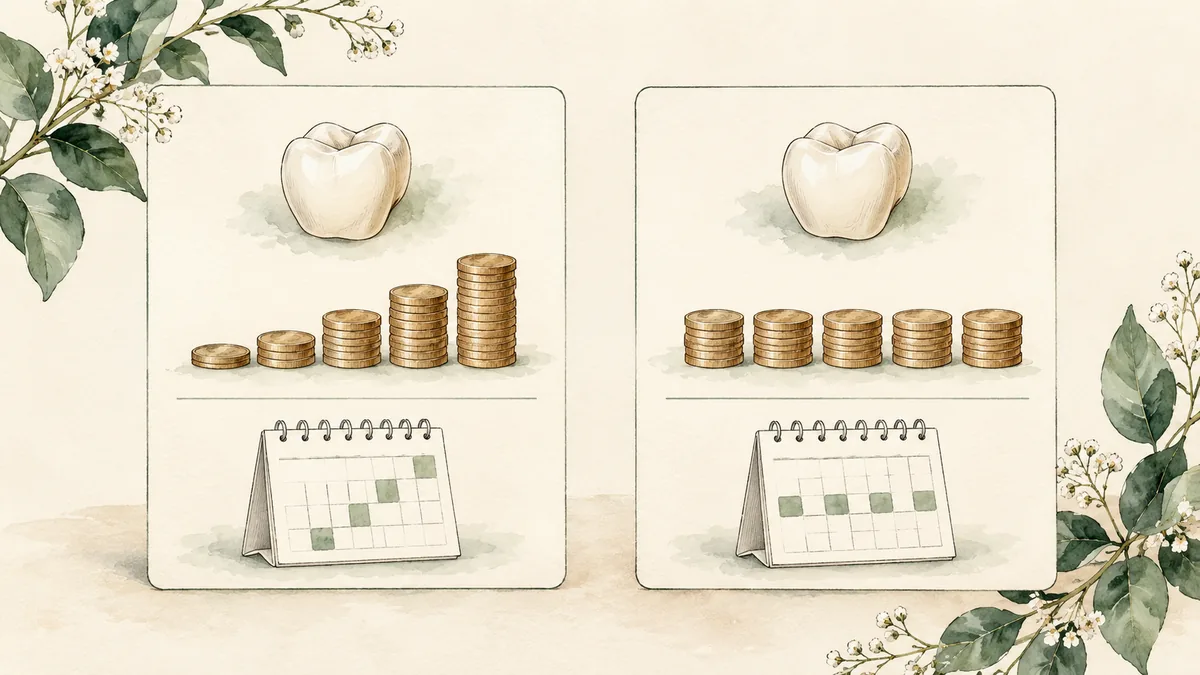
Here is an illustration in neutral units, not a price, to show why the monthly figure can mislead. Suppose two offers each borrow the same amount, which we call 1,000 units.
| Offer | Number of payments | Each payment | APR (our arithmetic) | Total repayable | Cost of credit |
|---|---|---|---|---|---|
| Offer A | 12 | 100 units | 41.3% | 1,200 units | 200 units |
| Offer B | 24 | 60 units | 45.1% | 1,440 units | 440 units |
Offer B looks cheaper each month and costs more overall. The arithmetic is the same for any real offer: multiply the payment by the number of payments, add any fees, and subtract what you borrowed to see the cost of credit. The APRs in the table are our own arithmetic on these invented terms, assuming monthly payments that start a month after the loan and no fees; a real APR needs the lender’s full terms. Ask the lender for its APR and for the total, and set the total beside the treatment quote you are comparing, as our page on private dental fees in the UK describes.
What happens at the end of a 0% offer?
If you have repaid the balance in full, nothing; if not, interest is charged on what remains. MoneyHelper says a 0% spending card costs nothing if you repay within the interest-free period, with expensive interest charged afterwards.2 The risk lies in the gap between the two, so find out:
- How long the interest-free period lasts, and the exact date it ends.
- What rate applies afterwards, and whether interest is charged on the full original balance.
- What happens to the 0% rate if you miss a payment.
- Whether you could realistically repay the whole balance before the period ends.
If the honest answer to the last question is no, the offer is not 0% for you. Work out the total you would owe if you only paid the minimum, and compare that with other options before you sign.
What should you ask before signing?
Before signing, ask who the lender is, what the APR and the total amount repayable are, what the fees are, what you would still owe if the treatment fails or is not completed, whether you get purchase protection, and whether the work can be staged. Get the answers in writing.
- Who is the lender? Ask whether the dentist or clinic is the lender, a broker or neither, and get the lender’s name in writing.
- What is the APR, and what is the total amount repayable? Get both in writing.
- What are the fees? Arrangement, late payment and early settlement fees all change the total.
- What happens if the treatment fails or is not completed? Ask whether you still owe the whole amount.
- Do I get purchase protection? A credit card may carry protection under section 75 of the Consumer Credit Act.5 A general personal loan is not usually linked to the seller, so ask the lender whether section 75 applies to the specific product.
- Can I pay less over a longer time, or stage the work? Our page on phased private treatment explains how.
What are the warning signs of pressure selling?
Finance can be sold as quickly as treatment. Warning signs include a credit agreement put in front of you on the day of the consultation, a “today only” offer, a stressed monthly payment with no mention of the total, being told not to read the paperwork, and being discouraged from comparing offers or taking time to think.
- You are asked to sign a credit agreement on the day of the consultation.
- An offer is described as available “today only”.
- The monthly payment is stressed and the total is not mentioned.
- You are told you do not need to read the paperwork because it is standard.
- You are discouraged from comparing the offer with another lender or from taking time to think.
None of these proves a problem, but any of them is a reason to ask for the terms in writing and to leave the room. You can compare the finance offer with the cost of the treatment itself using the figures on what dental treatment costs. Take your time, and remember that this is general information, not financial advice.
Frequently asked questions
-
Can I get 0% finance for dental treatment?
Some offers are interest-free for a period. A 0% spending card costs nothing if you repay within the interest-free period, but expensive interest is charged afterwards, so check the length of the period and what you will owe if you miss it. This is general information, not financial advice.
-
Does section 75 protect me if I pay by credit card?
It can, for a single item with a cash price of more than £100 and up to £30,000, bought directly from the trader. Paying a deposit by credit card can bring the whole item within section 75. We found no verified source on whether it applies when the dentist is overseas, so ask your card provider before you pay.
-
Is buy now, pay later regulated?
Partly. Deferred payment credit, a common form of buy now, pay later, has been regulated since 15 July 2026 when the lender is a separate business from the seller. The FCA says section 75 protection is available for regulated deferred payment credit. Check the terms of your offer and the date you took it out.
-
Is a personal loan a sensible way to pay for dental work?
We cannot advise you. A general personal loan is not usually linked to the seller, so ask the lender whether section 75 applies; if the treatment goes wrong, you may still owe the loan unless a protection applies. Compare the APR and the total amount repayable with other options, and consider whether a staged plan would reduce what you need to borrow.
-
What if my card provider refuses a claim?
Citizens Advice says that if a claim is refused you can take it to the Financial Ombudsman Service. Keep your contract, invoices, X-rays and all correspondence with the card provider and the dentist, and note the date of every call. See our page on the cost of putting dental work right for the wider picture.