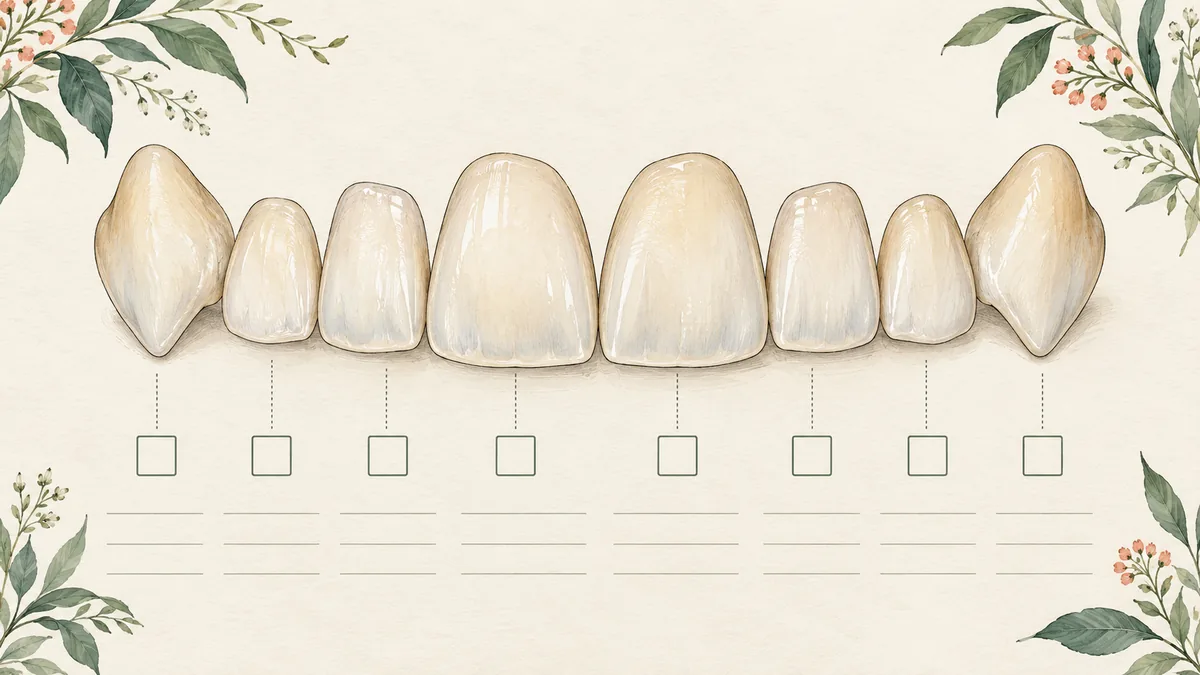
Search for “smile makeover” or “Hollywood smile” and you will find packages, not procedures. This page explains what the terms mean, what a makeover can combine, and the planning that should happen before anyone picks up a drill. It sits within our wider guide to cosmetic dental treatments.
The aim is not to put you off cosmetic dentistry, which can be done carefully and well. It is to make sure that you are buying a plan for your own teeth, and not a package that was decided before anyone looked at your mouth.
What do “smile makeover” and “Hollywood smile” mean?
Neither term is a diagnosis or a single operation. None of the clinical sources we used defines either one, which is itself informative: they are marketing labels. A review of smile analysis describes smile design as the process of creating an aesthetic smile on scientific and artistic guidelines.1
The review covers facial aesthetics, lip dynamics, the gum (“pink”) and tooth (“white”) aesthetics, and personality.1 That describes a planning process, not a package.
In practice “Hollywood smile” tends to mean very white, even, uniformly shaped front teeth, and it is applied to treatments that range from whitening to a full set of crowns or veneers. Because the label does not tell you what will be done to your teeth, the useful question is always “what, tooth by tooth?” The label also tells you nothing about what the NHS covers. The NHS says veneers are generally only available privately unless there is a clinical need, and that whitening is cosmetic and therefore generally only available privately.6
What can a smile makeover combine?
A makeover can include some or all of the following: whitening, composite bonding, veneers, crowns and implants. They are listed below from least to most invasive. Whitening changes only the colour of natural teeth, while implants replace teeth that are missing or cannot be saved.
- Whitening, which changes the colour of natural teeth and nothing else.
- Composite bonding, which builds up the tooth with tooth-coloured resin and removes little or none of it.
- Veneers, thin shells over the front of the tooth, which usually need some of the surface removed.
- Crowns, which cover the whole tooth and need the most reshaping.
- Implants, where teeth are missing or cannot be saved.
That order matters because the more invasive end is permanent. The Journal of Adhesive Dentistry review frames it as minimal intervention: direct composite veneers are usually less invasive of the tooth and easier to repair, while the preparation for indirect veneers is generally more invasive.4 The choice between a veneer and a crown for a given tooth is covered in our guide to crowns versus veneers, and the amounts of tooth involved are on the page about tooth preparation.
What planning should come first?
Smile design is a diagnostic process, not a shopping list. The review of smile analysis says a modern designer needs a global understanding of the entire patient, not only the teeth.1 In practice, that means four things should be looked at before any treatment is agreed:
- The health of the gums and the teeth underneath. Decay, gum disease and old fillings affect what is sensible. A plan made without up-to-date X-rays is a plan made without the facts.
- The bite and any tooth wear. The guide to managing tooth wear notes that restorations in severe wear from bruxism or erosion may have a limited lifetime, and that this should be explained as part of consent.5
- The face, lips and smile line. The shape and length of teeth should fit the face, which is why smile analysis looks at lip movement as well as teeth.
- A trial of the result. Ask whether you will see a trial of the proposed shape and colour before any tooth is touched.
One point deserves emphasis. The same guide says restorative treatment is not always indicated, even for patients with severe tooth wear.5 It adds that where a patient has no complaints, counselling and monitoring is probably the appropriate option.5 That is a statement about tooth wear rather than cosmetic work, but it shows how a good clinician thinks: the question is whether treatment is needed, not only which treatment to choose.
Why is “all 20 teeth” a clinical decision, not a package choice?
A package may be priced around a fixed number of teeth, such as “all 20”. The number of teeth to treat should come out of the diagnosis. If every tooth is offered the same treatment whatever its condition, the plan has been made before the examination.
Each prepared tooth has lost structure that does not come back, as our page on tooth preparation explains in detail. For that reason UK standards ask dentists to set out the alternatives. The GDC’s communication standard says that, before treatment, dentists should explain the options, including delaying treatment or doing nothing, with the risks and benefits of each.2
The review of veneers makes the same point from the evidence side: decisions must be based on sound evidence rather than on marketing hype or testimonials.4 A package that treats every tooth the same way is a marketing structure. If you are told you need all of them, ask for the reason for each tooth in writing.
How are shade and natural appearance decided?
Shade is a matter of judgement and preference, and we found no study that tells you which shade looks natural. What the smile-analysis literature does stress is that appearance depends on the whole face. The review lists facial aesthetics, lip dynamics and personality among the things a designer must consider.1
The practical points are these. A very white, uniform result is a choice, not a default, and the lightest shade is not automatically the most natural. Ask for the shade to be chosen in daylight, with the teeth next to your face and not on a screen, and for the chosen shade to be written on the plan. If whitening is part of the plan, read our page on whitening first, because restorations do not change colour once made.
What should you agree before starting?
UK dentists must provide a written plan and valid consent before treatment, and you can reasonably ask for the same anywhere. The GDC’s communication standard requires a written treatment plan before treatment starts, including the proposed treatment, a realistic cost and whether it is NHS or private.2
The standard also says patients should be told whether any guarantee applies, under what circumstances and for how long.2 These standards bind UK-registered dental teams and are not enforceable on a clinic in another country, but they are a clear benchmark of what to ask for anywhere.
The GDC’s consent standard requires valid consent, which means explaining all the relevant options and the possible costs.3 It lists the likely prognosis and what might happen without treatment among the things patients may want to know, and requires a reasonable time to consider the information.3
- The teeth to be treated, named individually, with the treatment for each.
- The alternatives, including a lower-intervention option and doing nothing.
- How much of each tooth will be removed and why.
- The material for each restoration, and what happens if one fails.
- The cost, itemised, and the terms of any guarantee.
- Time to think it over, with no pressure to decide that day.
Before you agree to any of it, check who will be treating you. Our guide to verifying a dentist explains how.
Frequently asked questions
-
What is a Hollywood smile?
It is a marketing term for a very white, even and uniform set of teeth, not a defined procedure. It can mean anything from whitening to a full set of veneers or crowns. Because the label does not say what will be done to your teeth, ask for the plan for each tooth in writing.
-
Is a smile makeover one treatment?
No. It is a plan that may combine whitening, bonding, veneers, crowns and sometimes implants, chosen to suit your teeth and face. The less invasive parts can be reversed or repaired more easily; preparing teeth for veneers or crowns cannot be undone. See crowns versus veneers for the choice.
-
Do I need all my teeth treated?
Not necessarily. The number of teeth should come from an examination, not from a package, so ask for the reason for each tooth in writing. UK standards require dentists to explain the options, including delaying treatment or doing nothing. Read about tooth preparation before agreeing to treat sound teeth.
-
Can I have a smile makeover on the NHS?
Cosmetic work is generally private. The NHS says veneers are generally only available privately unless there is a clinical need, and whitening is cosmetic. If a tooth is broken, decayed or worn, the NHS may be able to treat the problem itself, so ask your own dentist what it covers.
-
How long does a smile makeover last?
There is no single figure, because each part has its own lifespan and some parts, such as bonding, need more upkeep than others. A grinding habit can shorten the life of restorations. Ask for a replacement plan for each tooth, and for what happens if one fails.
-
Should I have a smile makeover abroad?
That is your decision, and the same questions apply anywhere: a written plan, individual teeth, the alternatives, the materials, the cost and the aftercare. The GDC standards cited here bind UK dentists, not a clinic abroad, so use them as a benchmark and do not accept pressure to decide quickly.